“Among multiple and varied hills, there is a great and very high mountain that seems to rise to the clouds, and it appears cut and cracked as if it were a saw. We arrived at its foothill, following a long, narrow and sinuous trail, after a long mile, we arrived in the breast of the mountain, were we found the incomparable monastery called Our Lady of Montserrat. The monks are Benedictine It is a very devout place. During day and night, twenty-three mostly gold and silver lamps burn continuously before its high altar. I also counted sixteen enormous wax candles there. Some of them weigh between ten and twelve centenarios, that are augmented every year by people from the surrounding towns, and on festival days, they burn from consecration to communion.
On Saturday morning, after hearing a devotional mass sung accompanied by an organ, we went up a very narrow, projecting trail, with stairs cut into the rock, and various precipices, like a stairway. Ascending this trail with tremendous labor, we arrived at the first hermitage, which has the name of Our Lady of Montserrat. Then, going further up, towards the left side, we came to the second, called the hermitage of the Holy Cross. On the third ascent, also very dangerous, we arrived at the hermitage of the Holy Trinity After the fourth and most dangerous ascent, with a lot of sweat, we were received at the fourth hermitage, which has the name of Holy Savior. But, tired from such a rough and steep climb, we didn't go up to the others.
Twelve hermitages are situated on the mountain, some higher, some lower. They are very nice and constructed beautifully. Each one has its pretty chapel, very well decorated with ornaments, very beautiful gardens: some hermitages have two, some three, according to the terrain around each one; dormitories, dining rooms, kitchens and other dependencies as well as cisterns. I enjoyed it so much, that I completely forgot about my recent efforts and fatigue. Some of the hermitages are dedicated to Saint Jerome, Saint Humphrey, Saint Catherine, Saint Anthony, etc.
After touring the cells, we arrived back at the monastery, by the same path, with great effort and in danger, in two hours, after midday.
After lunch, we entered the sacristy with the prior, a learned man, and looked at the cups and jeweled ornaments, exquisitely worked in gold and silver, which, according to the prior, were worth 800 marks. After that, we saw the ornaments that were very numerous and preciously woven with silk and gold and silver threads. Among other things, we saw a golden chain of four marks that King Fernando was wearing when a crazy man attacked him in Barcelona, and which he donated to the monastery the same year. It was a beautiful chain. I put it around my neck.
After this, leaving the monastery, we looked at the situation of the place, and ascending to a cave where, in the year 853, a certain citizen of Barcelona, Juan Garín, made a very exacting penitence The Virgin Mother of God works the greatest miracles every day. It would take too long to recount them all.
It would be meticulous as well to write about the miraculous fountain. Below the monastery is a castle that has a flowing fountain. Many years ago, a great multitude having gathered here for the feast of the Holy Virgin found themselves without water, because the noble owner refused to give them any, they went up to the monastery and there the water flowed, while that of the noble dried up. Today they call it the Fountain of the Miracle. We drank from it."
What Münzer Saw at Montserrat.
Montserrat is still one of the great landmarks of Catalonia and can be seen from many locations, with its distinctive saw-like shape. We here present a detail, as well as a view from the top--higher than Münzer's own vantage point The Monastery still exists, and so do the ermitas, and of course the miraculous Virgin herself. Giant candles, that last a year, are still burned. So does one of the chalices that Münzer probably saw, it’s now in the Museu de Montserrat. Juan Garín’s cave still exists as well.
As for the fountain, we couldn’t find it.
What Münzer never saw. (May 20, 2011)
The great Benedictine Monastery was completely rebuilt in 1594, and has been restored many times since. It is now a well-organized tourist attraction as well as a monastery, and is visited by scores of tour buses as well as individuals every day, not to mention those who stay at the on-site hotel. Cog railways also bring many visitors (there are regular trains to the mountain’s base from Barcelona.
The hermitages were also altered over time (the very last hermit died in 2003). The ones that Münzer saw are still accessible mainly to avid hikers. Santa Creu was where the last hermit died; while Santa Trinidat is reduced to a wall, part of the chapel and a cistern. The ones we visited were more accessible: a shorter cog-railway takes walkers to a site halfway between The monastery itself and the very summit of the mountain, to which there is a good hiking trail. This takes intrepid hikers to the hermitage of Sant Jeroní (Jerome). A paved trail also leads to the hermitage of Sant Miquel. Both have been restored, and Sant Miquel was totally rebuilt in 1870.
We did not get to Juan Garín’s cave, but among several caves on Montserrat, the most famous is the cave where the Virgin was found. It has its own cog-railway, a walk with stations of he cross by famous Catalan artists and architects, and the cave itself is enclosed within a modern shrine/church.
Most of the church treasures were not viewable—and certainly not King Fernando’s gold chain!
We are adding a nice link about Montserrat's hermits and their lifestyle.
In 1494-1495, Cartographer and Physician Hieronymus Münzer and three friends from Nuremberg made a trip through Spain and wrote about it. Follow us as we make their journey in the 21st century. We will post Münzer's observations, then our own, with photos of what is there now and how things have changed. We begin the quest on July 5!
Friday, May 20, 2011
Friday, May 13, 2011
Munzer in Barcelona Part 3
WHAT MUNZER COULD HAVE SEEN IN BARCELONA AND WHAT HE NEVER SAW
What Münzer Could Have seen in Barcelona
There are many more physical remains in Barcelona from the 15th century. We are not quoting Münzer’s historical accounts—they tend to be “fuzzy history” at best, as Ramon Alba pointed out in his 2000 translation of Münzer into Spanish. But Münzer was right in noting a steep decline in the city by the time he got there from its 13th-14th-century zenith. Most of the earlier infrastructure was maintained in the 15th century, so the metropolis was still impressive. What has survived is a patchwork: the former monastery churches of Santa Anna, Sant Pere de les Puelles, Sant Pau del Camp, and Santa Maria dels Jonquers, as well as part of the cloister of Sant Augustí Vell (found within a pastry-making academy). All have gone through periods of neglect, partial destruction, various restorations and in the case of Santa Maria dels Jonquers, a stone- by-stone moving to the Rambla de Catalunya near the Diagonal. Various palaces also survive as well as parts of other stone civic buildings and residences, and retablos, sculpture and church decorations as well as some domestic objects are divided between several museums (most prominently the Museu Nacional d’Art de Catalunya).
Once again, Münzer does not mention a single work of art except for the monstrance, though there are plenty of works of art that Art Historians consider important, such as Lluís Dalmau’s “Virgin of the Counselors around. One prominent citizen of the city was the Canon LLuís Desplà i Oms, Archdeacon and also president of Barelona’s Generalitat, whose sumptuous palace was being constructed facing the unfinished Cathedral façade, and incorporating parts of the old Roman walls. Though amalgamated with another palace, it’s still there and now houses the city archives. Desplà was an eager humanist, and would have certainly had a lot to discuss with a visiting intellectual like Münzer. Art historically, he is now chiefly remembered as having painted the “Pietà” by Bartolomé, now in the Cathedral museum, but originally in his private chapel.
What Münzer Never Would Have seen in Barcelona:
Take a look at a Google satellite map of Barcelona, and you can see the convoluted core of the medieval city, and the mitered grid beyond it of the post 1850’s city plan called the Eixemple, and later expansions beyond that. The city now fills all of Münzer’s “beautiful plain.” Though not from the highest tower in the city, the view from Montjüic below offers some idea of the city’s ever-growing extent. As Münzer would say, “for the sake of brevity I omit details,” but there are plenty of wonderful guidebooks that do a nice job of cataloging this urban growth.
After a long decline, Barcelona became very wealthy in the later 19th century, when the Eixemple was planned and built up. The Catalan language was also revived at this time. The end of the Spanish Civil war in 1939 ground everything to a screeching halt (Catalan was banned too), and the third revival began after Francisco Franco’s death I the 1970’s. Now the city is booming again, and there’s active restoration of many more sites, and a lot of creative reuse of old spaces. One of my favorites is the recycling of one of Barcelona’s two bull rings (Plaza de Toros las Arenas--in use 1900-1977) into a 3-story shopping mall.
What Münzer Could Have seen in Barcelona
There are many more physical remains in Barcelona from the 15th century. We are not quoting Münzer’s historical accounts—they tend to be “fuzzy history” at best, as Ramon Alba pointed out in his 2000 translation of Münzer into Spanish. But Münzer was right in noting a steep decline in the city by the time he got there from its 13th-14th-century zenith. Most of the earlier infrastructure was maintained in the 15th century, so the metropolis was still impressive. What has survived is a patchwork: the former monastery churches of Santa Anna, Sant Pere de les Puelles, Sant Pau del Camp, and Santa Maria dels Jonquers, as well as part of the cloister of Sant Augustí Vell (found within a pastry-making academy). All have gone through periods of neglect, partial destruction, various restorations and in the case of Santa Maria dels Jonquers, a stone- by-stone moving to the Rambla de Catalunya near the Diagonal. Various palaces also survive as well as parts of other stone civic buildings and residences, and retablos, sculpture and church decorations as well as some domestic objects are divided between several museums (most prominently the Museu Nacional d’Art de Catalunya).
Once again, Münzer does not mention a single work of art except for the monstrance, though there are plenty of works of art that Art Historians consider important, such as Lluís Dalmau’s “Virgin of the Counselors around. One prominent citizen of the city was the Canon LLuís Desplà i Oms, Archdeacon and also president of Barelona’s Generalitat, whose sumptuous palace was being constructed facing the unfinished Cathedral façade, and incorporating parts of the old Roman walls. Though amalgamated with another palace, it’s still there and now houses the city archives. Desplà was an eager humanist, and would have certainly had a lot to discuss with a visiting intellectual like Münzer. Art historically, he is now chiefly remembered as having painted the “Pietà” by Bartolomé, now in the Cathedral museum, but originally in his private chapel.
What Münzer Never Would Have seen in Barcelona:
Take a look at a Google satellite map of Barcelona, and you can see the convoluted core of the medieval city, and the mitered grid beyond it of the post 1850’s city plan called the Eixemple, and later expansions beyond that. The city now fills all of Münzer’s “beautiful plain.” Though not from the highest tower in the city, the view from Montjüic below offers some idea of the city’s ever-growing extent. As Münzer would say, “for the sake of brevity I omit details,” but there are plenty of wonderful guidebooks that do a nice job of cataloging this urban growth.
After a long decline, Barcelona became very wealthy in the later 19th century, when the Eixemple was planned and built up. The Catalan language was also revived at this time. The end of the Spanish Civil war in 1939 ground everything to a screeching halt (Catalan was banned too), and the third revival began after Francisco Franco’s death I the 1970’s. Now the city is booming again, and there’s active restoration of many more sites, and a lot of creative reuse of old spaces. One of my favorites is the recycling of one of Barcelona’s two bull rings (Plaza de Toros las Arenas--in use 1900-1977) into a 3-story shopping mall.
Munzer in Barcelona Part 2:
WHAT MUNZER SAW IN BARCELONA--THEN AND NOW
MUNZER: Barcelona Cathedral
“In the center, on a knoll, is the magnificent and superb Cathedral and Episcopal seat, dedicated in honor of the Holy Cross. This building is extraordinarily delicate, and in its periphery are more than twenty altars with magnificent and gilded panels, and an excellent library and a garden with orange trees, lemon trees and cypresses.
We were shown the great treasures of that church. Among other things, there was a beautiful monstrance, of about ninety four marks of purest gold, and decorated with so many pearls and precious stones, that it caused stupefaction. The church is also constructed in a surprising manner. Below the choir is the crypt, where the body of the virgin Saint Eulalia reposes, whom Diocletian crowned with martyrdom. In that crypt twenty lamps burn continuously. I ascended its [the Cathedral's] highest tower, as from a rampart; I contemplated at my leisure the city and its situation. Oh, what a splendid spectacle!
What Münzer Saw:
The Cathedral, of course, is still there, and Münzer would have seen the same basic structure as we do now. But there have been changes: a choir was added in the 16th century in the nave, the retablos, cleaned, restored and illuminated now by spotlights would have been brightly colored, but less visible. Whether they were lit or not would depend on who donated the oil lamps and candles that lit them, and if they had curtains over them or not. Though there are several of the 15th-century altarpieces still in chapels, none is in its original location. The cloister still has its lush foliage and citrus trees, as well as a resident flock of geese. The flock is dedicated to St. Eulalia, whose crypt can still be seen, though the modern illumination is controlled by a money-box by its grill.
One thing that’s there now that Münzer never saw was the “Gothic” façade of the Cathedral. It’s 19th century. In Münzer’s day, it was a blank wall.
The complex, 3-part monstrance is now in the Cathedral museum, along with some other precious objects, it is still magnificent, though now in a plexi-glass case. The view from the roof (towers are closed to visitors) is not particularly impressive (more on this later)
MUNZER: Other Religious Structures:
“The city has within its wall and beyond it, in an area of two leagues, more than thirty monasteries of monks and nuns, and I think that the city is twice as big as Nüremberg. For the most part, all the houses are constructed of dressed stone.
[The Convent of the Minor Brothers]: Near this house is the major monastery of the Order of Saint Francis, near the seashore. In the center of it there is another monastery, small, with a little cloister, refectory, cells and a small church, like a crypt, which Saint Francis had constructed, where he lived rigorously for some years, when the city was small. The church has just one square window, with iron bars, through which the sailors used to hear the Saint saying mass and preaching. Today, it still contains an ancient and simple image of the Blessed Virgin Mary, that was the adornment of this church, but it is beginning to crumble. Also found in the choir of the church of San Francis are the magnificent tombs of the Kings of Aragon. We contemplated the embalmed body of a Queen who had died eighty years ago, but is still intact. There is also a beautiful painting in the choir. There is a wonderful garden, watered by a mule, which drives a chain pump that continually takes water from a well that waters the entire garden by means of some canals.
The Monastery of Saint Dominic is also admirable, and in some aspects, not inferior to the preceding one mentioned. In both churches hang innumerable banners of the nobles buried there, that results in a handsome and magnificent spectacle.”
What Münzer saw:
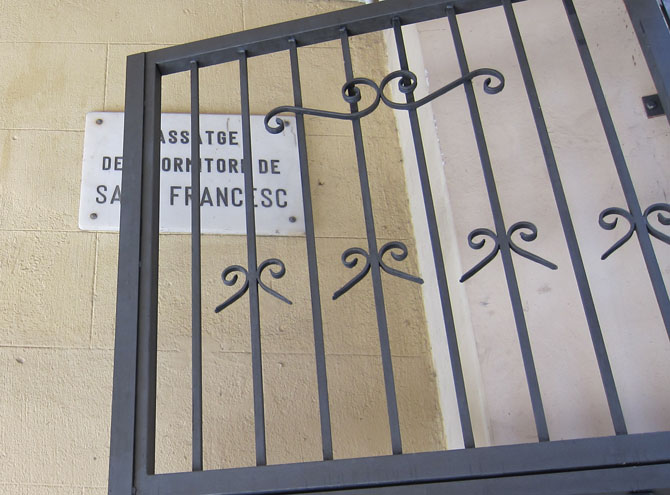
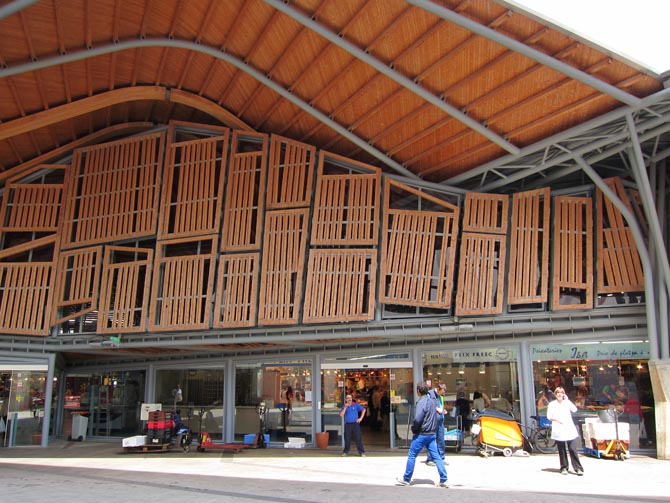
The churches of Santa Maria del Mar, Santa Maria del Pi and Sants Just i Pastor all more or less survive, now cleaned up and pristine—there have been many additions and subtractions over the years. The monasteries and convents are another thing. All were closed at the time of the 1835 exclaustration edicts, and most never recovered. What wasn’t destroyed then was damaged in 1909 and again in 1936. The Franciscan monastery is totally gone, except for one alley called the Passatge del Dormatori de San Francesc, near the port. The Dominican mastery of Santa Catalina has morphed into a big city Market (still called Santa Catalina). The tomb of the Queen that Münzer mentins, Sibil.la de Fortià still exists, she’s in the Museu Nacional d’Art de Catalunya, but is presently in hiding in storage
Münzer: Public Buildings
"[The Merchants' Exchange]:" A magnificent and superb house with a cupola is constructed by the sea, that one would think was a church or a great palace. Next to this building is a beautiful garden with ten rows of orange and lemon trees and in the center a dancing fountain, and on all four sides rectangular stone seats. In this building, twice a day, the merchants meet to carry on their business. The named it the llotja, that is, the exchange house. In it, there is a money exchange and a wisely regulated bank, to keep money.
[The Council Hall]: The city of Barcelona has a magnificent Council Hall, with a lovely garden and great palaces where the councilors—noble gentlemen—meet and settle the matters referring to the city. They showed us a big room full of books, that you would think was a library, where they preserve writings in a book for each year, and not only those that pertain to the tributes and to the government, but many other matters. And thus, when someone has a doubt about some matter that occurred many years before, he can know the year and the day; thanks to these journals, he can inquire about them with certainty."
What Münzer Saw:
The Llotja, or Merchant’s exchange exists, though now encased in a neoclassic shell with no garden. The original great exchange hall is within, and is now used for event functions. The Council Hall is also still in existence, though it too is fronted with a much later façade. If you wish to visit it, however, you have to be in the city on April 24th, Saint George’s day, when it’s open to the public.
Munzer: A palace:
"[The House of the Prince don Enrique]: The prince, don Enrique, who died in the bombardment of Naples in 1453, left a son of the same name. King Fernando, who is presently King of Spain, and the former, were the sons of two brothers. The prince decided for a life of idleness and pleasures rather than war. It was he who had constructed near the church of Saint Francis, such a superb and grandiose mansion, that no other can compare to it. We saw there a species of gazelle, which is an animal that has musk. It is bigger than a fox; the head, mouth and ears similar to an ermine, its color, blackish, scattered with many gray and white spots; the tail and paws of a dog; it is an angry and furious animal…….. Then they showed us a parrot as big as a grackle or a magpie, which was all white and gray, painted with various colors, primarily on the neck, like the falcons and sparrow hawks of Germany."
What Münzer Saw:
This palace is long gone, though there are several 15th century palaces in the Ciudat Vella—the best known are those preserved on the Carrer Montcada, one of which now houses the Picasso Museum. Less known is part of one to be found on Carrer Regomir,
Nobody in Spain has private animal collections, popular among wealthy nobles in the 15th century. But Barcelona has an excellent zoo.
MUNZER: Barcelona Cathedral
“In the center, on a knoll, is the magnificent and superb Cathedral and Episcopal seat, dedicated in honor of the Holy Cross. This building is extraordinarily delicate, and in its periphery are more than twenty altars with magnificent and gilded panels, and an excellent library and a garden with orange trees, lemon trees and cypresses.
We were shown the great treasures of that church. Among other things, there was a beautiful monstrance, of about ninety four marks of purest gold, and decorated with so many pearls and precious stones, that it caused stupefaction. The church is also constructed in a surprising manner. Below the choir is the crypt, where the body of the virgin Saint Eulalia reposes, whom Diocletian crowned with martyrdom. In that crypt twenty lamps burn continuously. I ascended its [the Cathedral's] highest tower, as from a rampart; I contemplated at my leisure the city and its situation. Oh, what a splendid spectacle!
What Münzer Saw:
The Cathedral, of course, is still there, and Münzer would have seen the same basic structure as we do now. But there have been changes: a choir was added in the 16th century in the nave, the retablos, cleaned, restored and illuminated now by spotlights would have been brightly colored, but less visible. Whether they were lit or not would depend on who donated the oil lamps and candles that lit them, and if they had curtains over them or not. Though there are several of the 15th-century altarpieces still in chapels, none is in its original location. The cloister still has its lush foliage and citrus trees, as well as a resident flock of geese. The flock is dedicated to St. Eulalia, whose crypt can still be seen, though the modern illumination is controlled by a money-box by its grill.
One thing that’s there now that Münzer never saw was the “Gothic” façade of the Cathedral. It’s 19th century. In Münzer’s day, it was a blank wall.
The complex, 3-part monstrance is now in the Cathedral museum, along with some other precious objects, it is still magnificent, though now in a plexi-glass case. The view from the roof (towers are closed to visitors) is not particularly impressive (more on this later)
MUNZER: Other Religious Structures:
“The city has within its wall and beyond it, in an area of two leagues, more than thirty monasteries of monks and nuns, and I think that the city is twice as big as Nüremberg. For the most part, all the houses are constructed of dressed stone.
[The Convent of the Minor Brothers]: Near this house is the major monastery of the Order of Saint Francis, near the seashore. In the center of it there is another monastery, small, with a little cloister, refectory, cells and a small church, like a crypt, which Saint Francis had constructed, where he lived rigorously for some years, when the city was small. The church has just one square window, with iron bars, through which the sailors used to hear the Saint saying mass and preaching. Today, it still contains an ancient and simple image of the Blessed Virgin Mary, that was the adornment of this church, but it is beginning to crumble. Also found in the choir of the church of San Francis are the magnificent tombs of the Kings of Aragon. We contemplated the embalmed body of a Queen who had died eighty years ago, but is still intact. There is also a beautiful painting in the choir. There is a wonderful garden, watered by a mule, which drives a chain pump that continually takes water from a well that waters the entire garden by means of some canals.
The Monastery of Saint Dominic is also admirable, and in some aspects, not inferior to the preceding one mentioned. In both churches hang innumerable banners of the nobles buried there, that results in a handsome and magnificent spectacle.”
What Münzer saw:
The churches of Santa Maria del Mar, Santa Maria del Pi and Sants Just i Pastor all more or less survive, now cleaned up and pristine—there have been many additions and subtractions over the years. The monasteries and convents are another thing. All were closed at the time of the 1835 exclaustration edicts, and most never recovered. What wasn’t destroyed then was damaged in 1909 and again in 1936. The Franciscan monastery is totally gone, except for one alley called the Passatge del Dormatori de San Francesc, near the port. The Dominican mastery of Santa Catalina has morphed into a big city Market (still called Santa Catalina). The tomb of the Queen that Münzer mentins, Sibil.la de Fortià still exists, she’s in the Museu Nacional d’Art de Catalunya, but is presently in hiding in storage
Münzer: Public Buildings
"[The Merchants' Exchange]:" A magnificent and superb house with a cupola is constructed by the sea, that one would think was a church or a great palace. Next to this building is a beautiful garden with ten rows of orange and lemon trees and in the center a dancing fountain, and on all four sides rectangular stone seats. In this building, twice a day, the merchants meet to carry on their business. The named it the llotja, that is, the exchange house. In it, there is a money exchange and a wisely regulated bank, to keep money.
[The Council Hall]: The city of Barcelona has a magnificent Council Hall, with a lovely garden and great palaces where the councilors—noble gentlemen—meet and settle the matters referring to the city. They showed us a big room full of books, that you would think was a library, where they preserve writings in a book for each year, and not only those that pertain to the tributes and to the government, but many other matters. And thus, when someone has a doubt about some matter that occurred many years before, he can know the year and the day; thanks to these journals, he can inquire about them with certainty."
What Münzer Saw:
The Llotja, or Merchant’s exchange exists, though now encased in a neoclassic shell with no garden. The original great exchange hall is within, and is now used for event functions. The Council Hall is also still in existence, though it too is fronted with a much later façade. If you wish to visit it, however, you have to be in the city on April 24th, Saint George’s day, when it’s open to the public.
Munzer: A palace:
"[The House of the Prince don Enrique]: The prince, don Enrique, who died in the bombardment of Naples in 1453, left a son of the same name. King Fernando, who is presently King of Spain, and the former, were the sons of two brothers. The prince decided for a life of idleness and pleasures rather than war. It was he who had constructed near the church of Saint Francis, such a superb and grandiose mansion, that no other can compare to it. We saw there a species of gazelle, which is an animal that has musk. It is bigger than a fox; the head, mouth and ears similar to an ermine, its color, blackish, scattered with many gray and white spots; the tail and paws of a dog; it is an angry and furious animal…….. Then they showed us a parrot as big as a grackle or a magpie, which was all white and gray, painted with various colors, primarily on the neck, like the falcons and sparrow hawks of Germany."
What Münzer Saw:
This palace is long gone, though there are several 15th century palaces in the Ciudat Vella—the best known are those preserved on the Carrer Montcada, one of which now houses the Picasso Museum. Less known is part of one to be found on Carrer Regomir,
Nobody in Spain has private animal collections, popular among wealthy nobles in the 15th century. But Barcelona has an excellent zoo.
Thursday, May 12, 2011
What Münzer Saw in Barcelona III
Other Religious Structures:
"The city has within its wall and beyond it, in an area of two leagues, more than thirty monasteries of monks and nuns, and I think that the city is twice as big as Nüremberg. For the most part, all the houses are constructed of dressed stone."
[The Convent of the Minor Brothers]: "Near this house is the major monastery of the Order of Saint Francis, near the seashore. In the center of it there is another monastery, small, with a little cloister, refectory, cells and a small church, like a crypt, which Saint Francis had constructed, where he lived rigorously for some years, when the city was small. The church has just one square window, with iron bars, through which the sailors used to hear the Saint saying mass and preaching. Today, it still contains an ancient and simple image of the Blessed Virgin Mary, that was the adornment of this church, but it is beginning to crumble. Also found in the choir of the church of San Francis are the magnificent tombs of the Kings of Aragon. We contemplated the embalmed body of a Queen who had died eighty years ago, but is still intact. There is also a beautiful painting in the choir. There is a wonderful garden, watered by a mule, which drives a chain pump that continually takes water from a well that waters the entire garden by means of some canals.
The Monastery of Saint Dominic is also admirable, and in some aspects, not inferior to the preceding one mentioned. In both churches hang innumerable banners of the nobles buried there, that results in a handsome and magnificent spectacle."
What Münzer saw:
The churches of Santa Maria del Mar, Santa Maria del Pi and Sants Just i Pastor all more or less survive, now cleaned up and pristine—there have been many additions and subtractions over the years. The monasteries and convents are another thing. All were closed at the time of the 1835 exclaustration edicts, and most never recovered. What wasn’t destroyed then was damaged in 1909 and again in 1936. The Franciscan monastery is totally gone, except for one alley called the Passatge del Dormatori de San Francesc, near the port. The Dominican mastery of Santa Catalina has morphed into a big city Market (still called Santa Catalina).
Public Buildings
[The Merchants' Exchange]: "A magnificent and superb house with a cupola is constructed by the sea, that one would think was a church or a great palace. Next to this building is a beautiful garden with ten rows of orange and lemon trees and in the center a dancing fountain, and on all four sides rectangular stone seats. In this building, twice a day, the merchants meet to carry on their business. The named it the llotja, that is, the exchange house. In it, there is a money exchange and a wisely regulated bank, to keep money."
[The Council Hall]: "The city of Barcelona has a magnificent Council Hall, with a lovely garden and great palaces where the councilors—noble gentlemen—meet and settle the matters referring to the city. They showed us a big room full of books, that you would think was a library, where they preserve writings in a book for each year, and not only those that pertain to the tributes and to the government, but many other matters. And thus, when someone has a doubt about some matter that occurred many years before, he can know the year and the day; thanks to these journals, he can inquire about them with certainty."
What Münzer Saw:
The Llotja, or Merchant’s exchange exists, though now encased in a neoclassic shell with no garden. The original great exchange hall is within, and is now used for event functions. The Council Hall is also still in existence, though it too is fronted with a much later façade. If you wish to visit it, however, you have to be in the city on April 24th, Saint George’s day, when it’s open to the public.
A palace:
[The House of the Prince don Enrique]: "The prince, don Enrique, who died in the bombardment of Naples in 1453, left a son of the same name. King Fernando, who is presently King of Spain, and the former, were the sons of two brothers. The prince decided for a life of idleness and pleasures rather than war. It was he who had constructed near the church of Saint Francis, such a superb and grandiose mansion, that no other can compare to it. We saw there a species of gazelle, which is an animal that has musk. It is bigger than a fox; the head, mouth and ears similar to an ermine, its color, blackish, scattered with many gray and white spots; the tail and paws of a dog; it is an angry and furious animal…….. Then they showed us a parrot as big as a grackle or a magpie, which was all white and gray, painted with various colors, primarily on the neck, like the falcons and sparrow hawks of Germany."
What Münzer Saw:
This palace is long gone, though there are several 15th century palaces in the Ciudat Vella—the best known are those preserved on the Carrer Montcada, one of which now houses the Picasso Museum. Less known is part of one to be found on Carrer Regomir,
Nobody in Spain has private animal collections, popular among wealthy nobles in the 15th century. But Barcelona has an excellent zoo.
"The city has within its wall and beyond it, in an area of two leagues, more than thirty monasteries of monks and nuns, and I think that the city is twice as big as Nüremberg. For the most part, all the houses are constructed of dressed stone."
[The Convent of the Minor Brothers]: "Near this house is the major monastery of the Order of Saint Francis, near the seashore. In the center of it there is another monastery, small, with a little cloister, refectory, cells and a small church, like a crypt, which Saint Francis had constructed, where he lived rigorously for some years, when the city was small. The church has just one square window, with iron bars, through which the sailors used to hear the Saint saying mass and preaching. Today, it still contains an ancient and simple image of the Blessed Virgin Mary, that was the adornment of this church, but it is beginning to crumble. Also found in the choir of the church of San Francis are the magnificent tombs of the Kings of Aragon. We contemplated the embalmed body of a Queen who had died eighty years ago, but is still intact. There is also a beautiful painting in the choir. There is a wonderful garden, watered by a mule, which drives a chain pump that continually takes water from a well that waters the entire garden by means of some canals.
The Monastery of Saint Dominic is also admirable, and in some aspects, not inferior to the preceding one mentioned. In both churches hang innumerable banners of the nobles buried there, that results in a handsome and magnificent spectacle."
What Münzer saw:
The churches of Santa Maria del Mar, Santa Maria del Pi and Sants Just i Pastor all more or less survive, now cleaned up and pristine—there have been many additions and subtractions over the years. The monasteries and convents are another thing. All were closed at the time of the 1835 exclaustration edicts, and most never recovered. What wasn’t destroyed then was damaged in 1909 and again in 1936. The Franciscan monastery is totally gone, except for one alley called the Passatge del Dormatori de San Francesc, near the port. The Dominican mastery of Santa Catalina has morphed into a big city Market (still called Santa Catalina).
Public Buildings
[The Merchants' Exchange]: "A magnificent and superb house with a cupola is constructed by the sea, that one would think was a church or a great palace. Next to this building is a beautiful garden with ten rows of orange and lemon trees and in the center a dancing fountain, and on all four sides rectangular stone seats. In this building, twice a day, the merchants meet to carry on their business. The named it the llotja, that is, the exchange house. In it, there is a money exchange and a wisely regulated bank, to keep money."
[The Council Hall]: "The city of Barcelona has a magnificent Council Hall, with a lovely garden and great palaces where the councilors—noble gentlemen—meet and settle the matters referring to the city. They showed us a big room full of books, that you would think was a library, where they preserve writings in a book for each year, and not only those that pertain to the tributes and to the government, but many other matters. And thus, when someone has a doubt about some matter that occurred many years before, he can know the year and the day; thanks to these journals, he can inquire about them with certainty."
What Münzer Saw:
The Llotja, or Merchant’s exchange exists, though now encased in a neoclassic shell with no garden. The original great exchange hall is within, and is now used for event functions. The Council Hall is also still in existence, though it too is fronted with a much later façade. If you wish to visit it, however, you have to be in the city on April 24th, Saint George’s day, when it’s open to the public.
A palace:
[The House of the Prince don Enrique]: "The prince, don Enrique, who died in the bombardment of Naples in 1453, left a son of the same name. King Fernando, who is presently King of Spain, and the former, were the sons of two brothers. The prince decided for a life of idleness and pleasures rather than war. It was he who had constructed near the church of Saint Francis, such a superb and grandiose mansion, that no other can compare to it. We saw there a species of gazelle, which is an animal that has musk. It is bigger than a fox; the head, mouth and ears similar to an ermine, its color, blackish, scattered with many gray and white spots; the tail and paws of a dog; it is an angry and furious animal…….. Then they showed us a parrot as big as a grackle or a magpie, which was all white and gray, painted with various colors, primarily on the neck, like the falcons and sparrow hawks of Germany."
What Münzer Saw:
This palace is long gone, though there are several 15th century palaces in the Ciudat Vella—the best known are those preserved on the Carrer Montcada, one of which now houses the Picasso Museum. Less known is part of one to be found on Carrer Regomir,
Nobody in Spain has private animal collections, popular among wealthy nobles in the 15th century. But Barcelona has an excellent zoo.
What Münzer Saw in Barcelona II
Münzer: Sept. 21-26, 1494 / Sobré: May 10-14, 2011
Barcelona Cathedral
"On a knoll, is the magnificent and superb Cathedral and Episcopal seat, dedicated in honor of the Holy Cross. This building is extraordinarily delicate, and in its periphery are more than twenty altars with magnificent and gilded panels, and an excellent library and a garden with orange trees, lemon trees and cypresses.
We were shown the great treasures of that church. Among other things, there was a beautiful monstrance, of about ninety four marks of purest gold, and decorated with so many pearls and precious stones, that it caused stupefaction. The church is also constructed in a surprising manner. Below the choir is the crypt, where the body of the virgin Saint Eulalia reposes, whom Diocletian crowned with martyrdom. In that crypt twenty lamps burn continuously. I ascended its [the Cathedral's] highest tower, as from a rampart; I contemplated at my leisure the city and its situation. Oh, what a splendid spectacle!
What Münzer Saw:
The Cathedral, of course, is still there, and Münzer would have seen the same basic structure as we do now. But there have been changes: a choir was added in the 16th century in the nave, the retablos, cleaned, restored and illuminated now by spotlights would have been brightly colored, but less visible. Whether they were lit or not would depend on who donated the oil lamps and candles that lit them, and if they had curtains over them or not. Though there are several of the 15th-century altarpieces still in chapels, none is in its original location. The cloister still has its lush foliage and citrus trees, as well as a resident flock of geese. The flock is dedicated to St. Eulalia, whose crypt can still be seen, though the modern illumination is controlled by a money-box by its grill.
One thing that’s there now that Münzer never saw was the “Gothic” façade of the Cathedral. It’s 19th century. In Münzer’s day, it was a blank wall.
The complex, 3-part custodial is now in the Cathedral museum, along with some other precious objects, it is still magnificent, though now in a plexi-glass case. The view from the roof (towers are closed to visitors) is not particularly impressive (more on this later)
Tuesday, May 10, 2011
Munzerama Phase 2: Munzer in Barcelona
Munzer in Barcelona – 1:
"On the 21st of this month [September], traveling from Girona for fourteen leagues. we arrived at the most noble city of Barcelona, situated on the banks of the Balearic [Mediterranean] Sea and the capital of all Catalonia. Its magnificently constructed walls of dressed stone, with merlons, crenellations and towers, surrounds its square periphery, right to the edge of the sea.
It is on a most beautiful plain bathed to the south by the sea, and to the east, west and north, it is surrounded by fertile mountains in a sort of semicircle. On the shore of the sea is built the most noble city of Barcelona. It has, as I have said, a very strong wall built all around it."
Judy's Commentary (May 10, 2011)
What Münzer Saw in Barcelona: 1
Barcelona is located on the Mediterranean coast, with the tall hills Montjüic to the south and Tibidabo to the east. To the north, it is flat, as, basically is the city itself. In Münzer’s time the city, like most European cities, was completely surrounded by walls, except along he immediate harbor (see The Wonderful Barcelona Map at the very end of the blog). The urbanized area extended from what is now the Ramblas, to the north, to El Born to the south. The eastern boundary was south of the present-day Plaça de Catalunya. North of the Rambla, a second set of walls had been built, but at this period, it was mostly agricultural, punctuated by a few convents.
"On the 21st of this month [September], traveling from Girona for fourteen leagues. we arrived at the most noble city of Barcelona, situated on the banks of the Balearic [Mediterranean] Sea and the capital of all Catalonia. Its magnificently constructed walls of dressed stone, with merlons, crenellations and towers, surrounds its square periphery, right to the edge of the sea.
It is on a most beautiful plain bathed to the south by the sea, and to the east, west and north, it is surrounded by fertile mountains in a sort of semicircle. On the shore of the sea is built the most noble city of Barcelona. It has, as I have said, a very strong wall built all around it."
Judy's Commentary (May 10, 2011)
What Münzer Saw in Barcelona: 1
Barcelona is located on the Mediterranean coast, with the tall hills Montjüic to the south and Tibidabo to the east. To the north, it is flat, as, basically is the city itself. In Münzer’s time the city, like most European cities, was completely surrounded by walls, except along he immediate harbor (see The Wonderful Barcelona Map at the very end of the blog). The urbanized area extended from what is now the Ramblas, to the north, to El Born to the south. The eastern boundary was south of the present-day Plaça de Catalunya. North of the Rambla, a second set of walls had been built, but at this period, it was mostly agricultural, punctuated by a few convents.
Thursday, July 29, 2010
The Art Historians Speak and what Happens Next
We finished Munzerama 1.0 on July 11. In the future, we hope to continue to follow Münzer's journey in the same manner to its conclusion. Please stay tuned. Any remarks so far are welcome!
As an art historian, what have I learned from this short journey so far?
The most obvious thing to me is that what was important to a 15th century visitor has little or nothing to do with the canon of quality that art historians have defined in the past century and a half. We have postulated important works and given the most importance to what has been academically defined as "Major Arts," i.e. Painting, Sculpture and Architecture, with such items as metalwork, textiles and ceramics relegated to a less important, minor status, not to mention painted and gilt trim on tombs and altarpiece frames, etc. In the past two decades, this whole issue is beginning to be redefined. Certainly in the late Middle Ages, price, effectiveness of function and the maker's skill and reputation in his profession were the great determinants. As far as religious architecture and objects are concerned, they were considered of a piece within the rituals of which they were a part, not as stand-alone "works of art." That they move us now has much more to do with our own cultural priorities and resonances.
This is equally true of the secular visual adornment market, which will be dealt with and made clear as Münzer's journey continues.
Secondly, there is no static "finished state," even when religious or other buildings were being constructed. Churches were continually modified over they centuries, parts destroyed intentionally or unintentionally and parts modified because of changes in ritual (and this is equally true, by the way of Christian churches and Jewish Synagogues). Since the mid-19th century, there have been modifications of another nature, as attempts to restore older churches have led to the purging of later additions, or the restoration of abandoned or degraded structures according to what can be surmised from documentation are undertaken. The Girona Cathedral we see now is quite different from what Münzer would have seen: in 1494, the building would have still had the Romanesque facade of the former structure that it gradually replaced (the Romanesque cloister is still retained). The east end of the nave would have been partially blocked by choir stalls. Many of its illustrious tombs would have probably been brightly painted with gilt detail, and certainly in better shape than they are now. Other altarpiece would have adorned its many chapels in both ambulatory and nave, and would have remained gated as they still are but also covered except when in use. Lighting, of course, would not have been electric, but rather hanging lamps. In short, the church would have been more adorned rather than the great, cleaned-up rather austere nave space we see today, though pews for the laity would have been non-existent.
In many other locations, reconstruction has gone much further. More will be said about this as we proceed.
As an art historian, what have I learned from this short journey so far?
The most obvious thing to me is that what was important to a 15th century visitor has little or nothing to do with the canon of quality that art historians have defined in the past century and a half. We have postulated important works and given the most importance to what has been academically defined as "Major Arts," i.e. Painting, Sculpture and Architecture, with such items as metalwork, textiles and ceramics relegated to a less important, minor status, not to mention painted and gilt trim on tombs and altarpiece frames, etc. In the past two decades, this whole issue is beginning to be redefined. Certainly in the late Middle Ages, price, effectiveness of function and the maker's skill and reputation in his profession were the great determinants. As far as religious architecture and objects are concerned, they were considered of a piece within the rituals of which they were a part, not as stand-alone "works of art." That they move us now has much more to do with our own cultural priorities and resonances.
This is equally true of the secular visual adornment market, which will be dealt with and made clear as Münzer's journey continues.
Secondly, there is no static "finished state," even when religious or other buildings were being constructed. Churches were continually modified over they centuries, parts destroyed intentionally or unintentionally and parts modified because of changes in ritual (and this is equally true, by the way of Christian churches and Jewish Synagogues). Since the mid-19th century, there have been modifications of another nature, as attempts to restore older churches have led to the purging of later additions, or the restoration of abandoned or degraded structures according to what can be surmised from documentation are undertaken. The Girona Cathedral we see now is quite different from what Münzer would have seen: in 1494, the building would have still had the Romanesque facade of the former structure that it gradually replaced (the Romanesque cloister is still retained). The east end of the nave would have been partially blocked by choir stalls. Many of its illustrious tombs would have probably been brightly painted with gilt detail, and certainly in better shape than they are now. Other altarpiece would have adorned its many chapels in both ambulatory and nave, and would have remained gated as they still are but also covered except when in use. Lighting, of course, would not have been electric, but rather hanging lamps. In short, the church would have been more adorned rather than the great, cleaned-up rather austere nave space we see today, though pews for the laity would have been non-existent.
In many other locations, reconstruction has gone much further. More will be said about this as we proceed.
Subscribe to:
Posts (Atom)