I marvel at the crushing pace of this journey; after four weeks on the road, with a car and a GPS, I am exhausted, and places visited seem to run together. Granted, Münzer’s journey took much longer, but it was still done at a punishing rate, considering horseback, bad roads or no roads and probable bad weather (though this is never mentioned). When did Münzer find time to write about all this, and see so much with fresh enthusiasm? Granted, some of his writing is formulaic of the time (contemporary travelers use many of the same terms and all finally get so overwhelmed that they lapse into “there’s so much that I can’t describe it all” rather often).
Münzer’s journey was one of privilege; he was passed from noble to noble, resident German to resident German; Emperor Maximilian must have been behind this relative ease of passage.
Other things stand out: you can’t trust Münzer’s accounts of history, as Ramón Alba has pointed out in the preface to his Spanish translation of the Itinerario, but this fuzzy history is within the 15th century tradition, not the documented histories that are produced now. As mentioned earlier, what we now consider as “works of art” was a completely alien concept then. Things of beauty were collected by the wealthy, but generally these were precious objects of precious materials. Paintings on wooden boards were considered part of furniture and decoration, whether religious or secular, but seldom collected as valuable (books were an exception). Portraits had just begun to be symbols of status—rank or occupation. When Münzer does mention a painting, an altarpiece or rarely a sculpted image, it’s usually because it was very new. This isn’t so different from fashion now. On the other hand, our concept of a Museum is alien to the 15th century. People did collect exotic animals and curiosities, but the idea of hanging paintings in a gallery—weather old or new, would have been thought of as strange. A religious painting, out of the context of its religious setting, whether at home in a private altar or a church, would have been unthinkable. In our time, we have recycled many of these images as “Works of Art,” removing them from their original function and context and placing our own values on them that have nothing to do with their original intent.
Saturday, June 11, 2011


Münzer on the Road: Málaga to Seville: Oct. 31-Nov. 4, 1494
Münzer:
"The day of October 30th, after midday, leaving Málaga and crossing some very high mountains like the Portalón, and also some valleys, where the King in time of war had had constructed a marvelous road to transport war matériel, passing on the left Ronda and Marbella, and many other villages and inns, we arrived the third day at Osuna, the city of the Marqués of Cádiz. We saw more than three hundred Saracens bound in chains there. Also, Marchena and Mairena, fortified plazas belonging to the same Marqués, were brimming with prisoners."
What Münzer Saw:
This was still of late Reconquest Country—at least the southern part of it. The landscape in this region is extremely beautiful, with cultivated high hills and valleys. Unlike along the Mediterranean coast, the farmland here is not terraced; rows of olive trees and other abundant crops are not only in the valleys, but are planted in rows straight over the hills. The abundance of castles along the way suggests the conflicts recent or older. In the town of Osuna, awnings covering the main street, though not described by Münzer, reflect ancient near-eastern traditions.

What Münzer Couldn’t Have Seen:
We think of the landscape as unchanging in its shape, but this is still earthquake country, and because of this, the shape of the landscape has changed, though only geologists could note the specific alterations. Even 50 years ago, the roads, certainly an improvement over Münzer’s time, were often single-lane, and off the main highways, dirt. What took the Germans days of travel were much faster in 1961, but are even faster and better now. What would the travelers have thought about cars, paved roads, wind generators, electricity, elevators and all the glassed-in stores? Did someone do laundry for them? He mentions being given clothes in Valencia by German merchants, but how much did they carry with them? Who guided them at night?
"The day of October 30th, after midday, leaving Málaga and crossing some very high mountains like the Portalón, and also some valleys, where the King in time of war had had constructed a marvelous road to transport war matériel, passing on the left Ronda and Marbella, and many other villages and inns, we arrived the third day at Osuna, the city of the Marqués of Cádiz. We saw more than three hundred Saracens bound in chains there. Also, Marchena and Mairena, fortified plazas belonging to the same Marqués, were brimming with prisoners."
What Münzer Saw:
This was still of late Reconquest Country—at least the southern part of it. The landscape in this region is extremely beautiful, with cultivated high hills and valleys. Unlike along the Mediterranean coast, the farmland here is not terraced; rows of olive trees and other abundant crops are not only in the valleys, but are planted in rows straight over the hills. The abundance of castles along the way suggests the conflicts recent or older. In the town of Osuna, awnings covering the main street, though not described by Münzer, reflect ancient near-eastern traditions.

What Münzer Couldn’t Have Seen:
We think of the landscape as unchanging in its shape, but this is still earthquake country, and because of this, the shape of the landscape has changed, though only geologists could note the specific alterations. Even 50 years ago, the roads, certainly an improvement over Münzer’s time, were often single-lane, and off the main highways, dirt. What took the Germans days of travel were much faster in 1961, but are even faster and better now. What would the travelers have thought about cars, paved roads, wind generators, electricity, elevators and all the glassed-in stores? Did someone do laundry for them? He mentions being given clothes in Valencia by German merchants, but how much did they carry with them? Who guided them at night?
Wednesday, June 8, 2011
Münzer in Málaga – Oct. 29-30, 1494
Münzer:
"The 29th of the same month, leaving the seacoast in the morning, we arrived in Málaga, five leagues away. A maritime and populous city, it is notable for its famous port. This journey was extremely dangerous, because of the Saracens, who at night, when the winds are favorable, came from Barbary, and knowing the situation of the place, robbed anyone they encountered before sunrise, and carried away prisoners with them. Recently, they abducted some shepherds and five farmers.
The city is circular, or actually more in the form of a triangle and as big as Nördlingen. When it was at its apogee under the Saracens it had seven thousand houses. There are two very beautiful gates, like semicircles, with three very strong towers at the angles. Towards the west end there is a great building with seven arches for the docking of boats and galleys, and a very lovely mosque with a hundred and thirteen free standing columns, that is now the Episcopal seat.
It has also three monasteries of minor brothers, of preachers, and a new foundation of minor brothers at the head of which is the Aragonese brother Bernardo de Boil, who was sent to the Indies as a true discoverer. His intimate preferential treatment in Madrid served me well before the King, and he spoke to me a lot about those islands. The monastery is situated towards the south, on a very fertile plain, with very leafy abundant gardens in former times, but now destroyed because of the siege.
In the great mosque the King set up a handsome tablet in honor of Saint John the Baptist, who is his patron saint. The king is painted on it, holding in his hand a cartouche that reads: "Non nobis domine, ,etc., and the Queen, holding another with: "Benedicte sit sancta Trinitas et indivisa Unitas, que fecit misericordiam nobis."
[The Castles of Málaga]: In the foothills of the mountain, facing towards the east from the city, is a notable and very beautiful castle, very strong, decorated with many iron gates and very diverse locks. Oh, how beautiful is also the spectacle next to the seaport! It also has three caves or great cavities in the very hard rock, like those in Granada, where Christian captives and many other things were held. The castle governor received us affably, thanks to our letters of introduction, and one of his servants took us up to the high castle fortress, situated on the mountain top, within two sets of walls. Oh, what a marvelous and well-fortified castle! From there, on clear days, one can easily make out Africa and Barbary. It measures a distance of fifteen short miles. We also saw a charming little royal mosque, and some notable displays of mosaics in the Moorish style.
In the month of January—ten months ago—Málaga suffered a terrible earthquake, which destroyed many buildings and towers. And it caused such a rise in the earth at the port, that many boats were beached until the earth sank again on waves of wind."
What Münzer Saw:
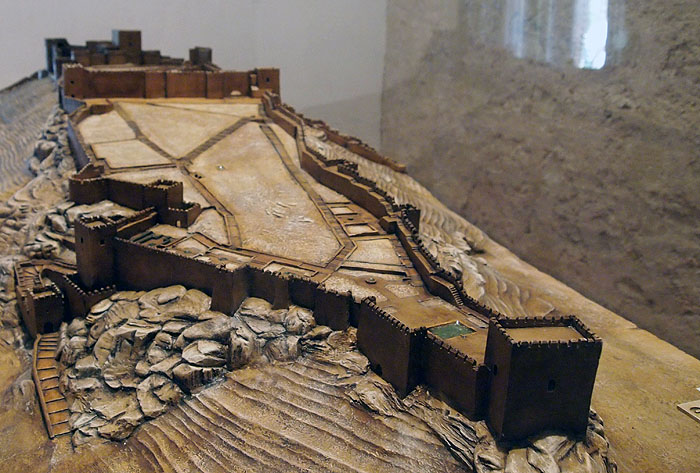
The triple-walled Fortresses of the Alcazaba (on the lower hillside) and Gibalfarro (up the hill) are the only architectural remains of the Nasrids and their predecessors, so recently conquered by Fernando and Isabel (1487). A model in the Gibalfarro information center shows what the fortresses would have looked like, and the almost-circular city, as it existed at that time.
The great mosque declared a Cathedral has long disappeared; construction on the present Cathedral began on the site in the 16th century, and was completed in the 18th. The tablet that King Fernando set up in the converted mosque has disappeared.
The Dominican monastery still exists, though again much altered. It was outside the city walls in the late 15th century.
Like most other southern Spanish cities, Málaga has had its share of earthquakes, and at the time Münzer visited, most of the city had been destroyed by one, much like Almería.


What Münzer Could Have Seen:
Several other churches were being constructed over conquered mosques, including San Juan Bautista. All have been so changed over the years that no original traces remain (the latest restoration of San Juan, in a tasteful Baroque style, was completed in 2009.
One thing he could have seen was an image of the Virgin and Child that had been donated to the newly-proclaimed Cathedral by the Catholic Kings, and is one of the few pieces that was there in the late 15th century; it was augmented by glamorized images of Fernando and Isabel by Pedro de Mena, the best-known sculptor of 17th-century Málaga.

What Münzer Never Would Have seen (us: June 7-8, 2011):
Münzer was alive too early to see the sensational images of the Crucified Christ and the Virgin Mary, kept in the chapels of its numerous parishes and processed during Holy Week. The Virgin figures have crystal tears, rich crowns and ever-changing wardrobes
Numerous natural disasters have struck the city over the centuries: more earthquakes, a tsunami, plague and cholera epidemics, and phylloxeria, which practically wiped out Málaga’s grape crop—as important for making its famous raisins as for its sweet wines. The city now is modern, and, not surprisingly, spread in all directions. It is still an important port, but now big container ships are unloaded here, and it’s a popular stop for cruise lines, and it is also surrounded by beach resort towns such as Torremolinos and Marbella. Aside from Pedro de Mena, Picasso was born here too.
So far as we can tell, you can’t see Africa from the city, even on a clear day—certainly not from the Gibalfarro fortress, though we tried.


A Note: Julio Benitez, art historian, photographer, friend and fabulous traveling companion, leaves this project tomorrow to go on to Germany, and then back to San Antonio and finally moving to Iowa with his terrific wife. He'll be sorely missed.
"The 29th of the same month, leaving the seacoast in the morning, we arrived in Málaga, five leagues away. A maritime and populous city, it is notable for its famous port. This journey was extremely dangerous, because of the Saracens, who at night, when the winds are favorable, came from Barbary, and knowing the situation of the place, robbed anyone they encountered before sunrise, and carried away prisoners with them. Recently, they abducted some shepherds and five farmers.
The city is circular, or actually more in the form of a triangle and as big as Nördlingen. When it was at its apogee under the Saracens it had seven thousand houses. There are two very beautiful gates, like semicircles, with three very strong towers at the angles. Towards the west end there is a great building with seven arches for the docking of boats and galleys, and a very lovely mosque with a hundred and thirteen free standing columns, that is now the Episcopal seat.
It has also three monasteries of minor brothers, of preachers, and a new foundation of minor brothers at the head of which is the Aragonese brother Bernardo de Boil, who was sent to the Indies as a true discoverer. His intimate preferential treatment in Madrid served me well before the King, and he spoke to me a lot about those islands. The monastery is situated towards the south, on a very fertile plain, with very leafy abundant gardens in former times, but now destroyed because of the siege.
In the great mosque the King set up a handsome tablet in honor of Saint John the Baptist, who is his patron saint. The king is painted on it, holding in his hand a cartouche that reads: "Non nobis domine, ,etc., and the Queen, holding another with: "Benedicte sit sancta Trinitas et indivisa Unitas, que fecit misericordiam nobis."
[The Castles of Málaga]: In the foothills of the mountain, facing towards the east from the city, is a notable and very beautiful castle, very strong, decorated with many iron gates and very diverse locks. Oh, how beautiful is also the spectacle next to the seaport! It also has three caves or great cavities in the very hard rock, like those in Granada, where Christian captives and many other things were held. The castle governor received us affably, thanks to our letters of introduction, and one of his servants took us up to the high castle fortress, situated on the mountain top, within two sets of walls. Oh, what a marvelous and well-fortified castle! From there, on clear days, one can easily make out Africa and Barbary. It measures a distance of fifteen short miles. We also saw a charming little royal mosque, and some notable displays of mosaics in the Moorish style.
In the month of January—ten months ago—Málaga suffered a terrible earthquake, which destroyed many buildings and towers. And it caused such a rise in the earth at the port, that many boats were beached until the earth sank again on waves of wind."
What Münzer Saw:
The triple-walled Fortresses of the Alcazaba (on the lower hillside) and Gibalfarro (up the hill) are the only architectural remains of the Nasrids and their predecessors, so recently conquered by Fernando and Isabel (1487). A model in the Gibalfarro information center shows what the fortresses would have looked like, and the almost-circular city, as it existed at that time.
The great mosque declared a Cathedral has long disappeared; construction on the present Cathedral began on the site in the 16th century, and was completed in the 18th. The tablet that King Fernando set up in the converted mosque has disappeared.
The Dominican monastery still exists, though again much altered. It was outside the city walls in the late 15th century.
Like most other southern Spanish cities, Málaga has had its share of earthquakes, and at the time Münzer visited, most of the city had been destroyed by one, much like Almería.


What Münzer Could Have Seen:
Several other churches were being constructed over conquered mosques, including San Juan Bautista. All have been so changed over the years that no original traces remain (the latest restoration of San Juan, in a tasteful Baroque style, was completed in 2009.
One thing he could have seen was an image of the Virgin and Child that had been donated to the newly-proclaimed Cathedral by the Catholic Kings, and is one of the few pieces that was there in the late 15th century; it was augmented by glamorized images of Fernando and Isabel by Pedro de Mena, the best-known sculptor of 17th-century Málaga.

What Münzer Never Would Have seen (us: June 7-8, 2011):
Münzer was alive too early to see the sensational images of the Crucified Christ and the Virgin Mary, kept in the chapels of its numerous parishes and processed during Holy Week. The Virgin figures have crystal tears, rich crowns and ever-changing wardrobes
Numerous natural disasters have struck the city over the centuries: more earthquakes, a tsunami, plague and cholera epidemics, and phylloxeria, which practically wiped out Málaga’s grape crop—as important for making its famous raisins as for its sweet wines. The city now is modern, and, not surprisingly, spread in all directions. It is still an important port, but now big container ships are unloaded here, and it’s a popular stop for cruise lines, and it is also surrounded by beach resort towns such as Torremolinos and Marbella. Aside from Pedro de Mena, Picasso was born here too.
So far as we can tell, you can’t see Africa from the city, even on a clear day—certainly not from the Gibalfarro fortress, though we tried.


A Note: Julio Benitez, art historian, photographer, friend and fabulous traveling companion, leaves this project tomorrow to go on to Germany, and then back to San Antonio and finally moving to Iowa with his terrific wife. He'll be sorely missed.
Saturday, June 4, 2011
Münzer At The Alhambra
Münzer:
[The Fortress of Granada Called The Alhambra]: After lunch, we went up again to the Alhambra, on a very high mountain. Ascending a good stretch, we entered into a place that was the prison for Christian captives. At times, there were seven thousand captives between that place and the houses of the Saracens in the city. But in the time of the siege so many died of hunger, that very few remained when Granada was taken; only 1500 remained alive, who were presented to the king when he entered victorious into Granada.
Having entered into the fortress through many iron gates, with many soldiers and officials' rooms, we arrived finally at the superb and sumptuous palace of the governor, whose name is Iñigo López, of the house of Mendoza of Castile, Count of Tendilla and Governor of Granada…who gave us a fine welcome. We saw there uncounted palaces, paved with the whitest marble, gorgeous gardens, adorned with lemon and myrtle trees with benches and lounges of marble at the sides; also four rooms filled with arms, lances, crossbows, swords, armor and arrows, sumptuous bedrooms and chambers; in every room, many basins of very white marble; in the center of one of the palaces a great basin of marble that rests over thirteen [sic ]sculpted lions, also of the whitest marble, with water gushing from each mouth as in a canal. All of this is so superb, magnificent and exquisitely constructed, of so many diverse materials, that you would believe yourself in a paradise.
There was in the bath a beautiful marble basin, where the wives and concubines bathed nude. The king, from a screened place above—and which we saw— contemplated them, and to the one who most pleased him, he threw an apple as a sign that he would sleep with her that night.
All the palaces and rooms, in the upper part, have such superb inlaid ceilings and ceiling tiles made with gold, lapis lazuli, marble and cypress, of such varying styles, that one can't write about them or describe them. We went up to the top of two very high towers and contemplated the situation of the city, but one can scarcely see half of it. I don't think there is a bigger city in all Europe nor in Africa.
There are many Saracens building in the city. There are also many of them who are reconstructing the fortress and royal sites that were left in ruins, since the King of Granada, after realizing that he could resist the most Christian King of Spain, allowed many buildings to be destroyed…when we were there, we saw many Saracens adorning and restoring the paintings and other things with their characteristic delicacy.
Within the Alhambra there is a superb and noble mosque—that is now dedicated to the Blessed Virgin Mary and is the seat of an archbishop. A monastery has also been founded of the Minor Brothers of the Order of Saint Francis. The king has, beyond the walls of the Alhambra, at the top of a mountain, a truly royal and very famous garden, with fountains, a pool, and little brooks, so exquisitely constructed by the Saracens, that there is none better.
What Münzer saw:
Münzer may not have been the very first non-Spaniard to visit the Alhambra after Fernando and Isabella appropriated it, but was the first to report on it (and his account has been used by archaeologists and art historians involved in its reconstruction). He would have been able to see everything accessible, thanks to his contact with the Count of Tendilla, the man whom the Catholic monarchs entrusted with its administration (Münzer and his companions relied on letters of introduction from the governor of Almería, a practice they had been taking advantage of throughout their trip—you get the current person with connections to recommend you on to the next stop—a late medieval version of Tripadvisor.com, making appointments to get into places in advance, and flashing your business card).
The Alhambra, according to our traveler, was not a pristine royal city, though it was dazzling as it stood. Although he attributes damage to the palaces to the siege by the Christians, it had been falling into disrepair under the last few turbulent and often short-lived Nasrid regimes. The Catholic Kings, as our chronicler remarked, were not only having local craftspeople restoring damages to the palaces, but also adapting them to their needs. There were many more palaces then than there are now; as a matter of fact, the Palace of Yusuf III, where Münzer was received by the Count, is now reduced to gardens and a few walls. Visitors today see only two: the Palacios de Comares and Leones.
In the fortress-city, the Catholic Kings had already founded a Franciscan monastery and changed the main mosque to a church, as well as rigging a bell on the foremost tower of the Alcazaba, the fortified military section of the site, where Münzer took in the view.


What’s There Now: (June 3, 2011)
Münzer certainly saw the two extant palaces—he mentions the luxurious bath of the Comares Palace, where the King chose his bed partners from his harem, and the famous Lion Fountain, with its twelve, (not thirteen) stylized marble beasts. He would have seen much more in the way of precious adornments, wooden screens and doors, fine pottery, Nasrid textiles—a few of these are still in the Archeological museum. The gorgeous inlaid wooden ceilings and the complex domes adorned with muqqarnas that look like a forest of icicles have been carefully restored and cleaned. And the fabulous gardens, big and small on many levels and with carefully planned balcony views of some from various palace rooms are still visible. Something of the spirit of this independent, opulent, highly fortified royal city still exists.


What Münzer Would Never Have Seen:
Aside from the tourists who swarm the site, Münzer would have been spared Charles V’s massive circle-within square palace built as a 16th-century symbol of the triumph of Renaissance Christianity that dominates the space between the military zone and the delicate palaces, as well as the small but equally monolithic church dedicated to the Virgin near it that replaced the old mosque. The former Franciscan convent is now a luxury Parador, where visitors can sample a reconstructed Nasrid menu.
But above all, visits to the Nasrid palaces are now highly structured: a permanent blockbuster exhibition, tickets must be purchased in advance, metered with a prescribed start time, and a visitor’s time and access within the splendid buildings are limited. A gaggle of cameras click, groups ooh and ahhh and march ever onwards.
At the time of this visit, the lion fountain is dismantled; it’s being restored and the water system of its fountain improved. For this reason, access to the Lion Palace is cut back, and its gorgeous courtyard is off limits, covered with scaffolding.
The Art Historian Speaks:
I’ll admit I’m prejudiced: Charles’s Palace is a bull in the Nasrid china shop, its heavy rusticated façade and bare circular courtyard is such an eyesore (and the church of the Virgin is not really a good fit either). But Charles probably loved his palace. It was then in the latest style (even though it was never finished during his lifetime).
Like every historical site, what we see now is very different from a living, breathing Nasrid royal city. Beautiful as they are, these palaces were not built to last (successive kings built new ones, and though gorgeous, the building materials were inexpensive and their decorations ephemeral). Napoleon’s troops really trashed the place, and when Washington Irving visited in the 19th century, the surviving palaces were in a state of picturesque ruin. I first visited the Alhambra in 1965, forty years after Architectural historian Torras Balbas supervised the first restoration campaign. At that time of year (December) there weren’t many visitors, and you could linger anywhere for a long as you liked. In 1973, the International Congress of the History of Art was held in Granada and attendees had the Alhambra, for a few magical hours, all to themselves. Andrés Segovia gave a guitar concert in the lion court, and there was an evening cocktail reception with various bands tucked into corners of the Generalife Gardens just for us. Maybe that captured some of the spirit of the glory days—but maybe not.
There are not many photos in this particular blog entry. So many terrific guidebooks and photographs are out there, both in print and on the web, that I’ll leave you to graze them yourselves.

The Art Historian Speaks:
I’ll admit I’m prejudiced: Charles’s Palace is a bull in the Nasrid china shop, its heavy rusticated façade and bare circular courtyard is such an eyesore (and the church of the Virgin is not really a good fit either). But Charles probably loved his palace. It was then in the latest style (even though it was never finished during his lifetime).
Like every historical site, what we see now is very different from a living, breathing Nasrid royal city. Beautiful as they are, these palaces were not built to last (successive kings built new ones, and though gorgeous, the building materials were inexpensive and their decorations ephemeral). Napoleon’s troops really trashed the place, and when Washington Irving visited in the 19th century, the surviving palaces were in a state of picturesque ruin. I first visited the Alhambra in 1965, forty years after Architectural historian Torras Balbas supervised the first restoration campaign. At that time of year (December) there weren’t many visitors, and you could linger anywhere for a long as you liked. In 1973, the International Congress of the History of Art was held in Granada and attendees had the Alhambra, for a few magical hours, all to themselves. Andrés Segovia gave a guitar concert in the lion court, and there was an evening cocktail reception with various bands tucked into corners of the Generalife Gardens just for us. Maybe that captured some of the spirit of the glory days—but maybe not.
There are not many photos in this particular blog entry. So many terrific guidebooks and photographs are out there, both in print and on the web, that I’ll leave you to graze them yourselves.
[The Fortress of Granada Called The Alhambra]: After lunch, we went up again to the Alhambra, on a very high mountain. Ascending a good stretch, we entered into a place that was the prison for Christian captives. At times, there were seven thousand captives between that place and the houses of the Saracens in the city. But in the time of the siege so many died of hunger, that very few remained when Granada was taken; only 1500 remained alive, who were presented to the king when he entered victorious into Granada.
Having entered into the fortress through many iron gates, with many soldiers and officials' rooms, we arrived finally at the superb and sumptuous palace of the governor, whose name is Iñigo López, of the house of Mendoza of Castile, Count of Tendilla and Governor of Granada…who gave us a fine welcome. We saw there uncounted palaces, paved with the whitest marble, gorgeous gardens, adorned with lemon and myrtle trees with benches and lounges of marble at the sides; also four rooms filled with arms, lances, crossbows, swords, armor and arrows, sumptuous bedrooms and chambers; in every room, many basins of very white marble; in the center of one of the palaces a great basin of marble that rests over thirteen [sic ]sculpted lions, also of the whitest marble, with water gushing from each mouth as in a canal. All of this is so superb, magnificent and exquisitely constructed, of so many diverse materials, that you would believe yourself in a paradise.
There was in the bath a beautiful marble basin, where the wives and concubines bathed nude. The king, from a screened place above—and which we saw— contemplated them, and to the one who most pleased him, he threw an apple as a sign that he would sleep with her that night.
All the palaces and rooms, in the upper part, have such superb inlaid ceilings and ceiling tiles made with gold, lapis lazuli, marble and cypress, of such varying styles, that one can't write about them or describe them. We went up to the top of two very high towers and contemplated the situation of the city, but one can scarcely see half of it. I don't think there is a bigger city in all Europe nor in Africa.
There are many Saracens building in the city. There are also many of them who are reconstructing the fortress and royal sites that were left in ruins, since the King of Granada, after realizing that he could resist the most Christian King of Spain, allowed many buildings to be destroyed…when we were there, we saw many Saracens adorning and restoring the paintings and other things with their characteristic delicacy.
Within the Alhambra there is a superb and noble mosque—that is now dedicated to the Blessed Virgin Mary and is the seat of an archbishop. A monastery has also been founded of the Minor Brothers of the Order of Saint Francis. The king has, beyond the walls of the Alhambra, at the top of a mountain, a truly royal and very famous garden, with fountains, a pool, and little brooks, so exquisitely constructed by the Saracens, that there is none better.
What Münzer saw:
Münzer may not have been the very first non-Spaniard to visit the Alhambra after Fernando and Isabella appropriated it, but was the first to report on it (and his account has been used by archaeologists and art historians involved in its reconstruction). He would have been able to see everything accessible, thanks to his contact with the Count of Tendilla, the man whom the Catholic monarchs entrusted with its administration (Münzer and his companions relied on letters of introduction from the governor of Almería, a practice they had been taking advantage of throughout their trip—you get the current person with connections to recommend you on to the next stop—a late medieval version of Tripadvisor.com, making appointments to get into places in advance, and flashing your business card).
The Alhambra, according to our traveler, was not a pristine royal city, though it was dazzling as it stood. Although he attributes damage to the palaces to the siege by the Christians, it had been falling into disrepair under the last few turbulent and often short-lived Nasrid regimes. The Catholic Kings, as our chronicler remarked, were not only having local craftspeople restoring damages to the palaces, but also adapting them to their needs. There were many more palaces then than there are now; as a matter of fact, the Palace of Yusuf III, where Münzer was received by the Count, is now reduced to gardens and a few walls. Visitors today see only two: the Palacios de Comares and Leones.
In the fortress-city, the Catholic Kings had already founded a Franciscan monastery and changed the main mosque to a church, as well as rigging a bell on the foremost tower of the Alcazaba, the fortified military section of the site, where Münzer took in the view.


What’s There Now: (June 3, 2011)
Münzer certainly saw the two extant palaces—he mentions the luxurious bath of the Comares Palace, where the King chose his bed partners from his harem, and the famous Lion Fountain, with its twelve, (not thirteen) stylized marble beasts. He would have seen much more in the way of precious adornments, wooden screens and doors, fine pottery, Nasrid textiles—a few of these are still in the Archeological museum. The gorgeous inlaid wooden ceilings and the complex domes adorned with muqqarnas that look like a forest of icicles have been carefully restored and cleaned. And the fabulous gardens, big and small on many levels and with carefully planned balcony views of some from various palace rooms are still visible. Something of the spirit of this independent, opulent, highly fortified royal city still exists.


What Münzer Would Never Have Seen:
Aside from the tourists who swarm the site, Münzer would have been spared Charles V’s massive circle-within square palace built as a 16th-century symbol of the triumph of Renaissance Christianity that dominates the space between the military zone and the delicate palaces, as well as the small but equally monolithic church dedicated to the Virgin near it that replaced the old mosque. The former Franciscan convent is now a luxury Parador, where visitors can sample a reconstructed Nasrid menu.
But above all, visits to the Nasrid palaces are now highly structured: a permanent blockbuster exhibition, tickets must be purchased in advance, metered with a prescribed start time, and a visitor’s time and access within the splendid buildings are limited. A gaggle of cameras click, groups ooh and ahhh and march ever onwards.
At the time of this visit, the lion fountain is dismantled; it’s being restored and the water system of its fountain improved. For this reason, access to the Lion Palace is cut back, and its gorgeous courtyard is off limits, covered with scaffolding.
The Art Historian Speaks:
I’ll admit I’m prejudiced: Charles’s Palace is a bull in the Nasrid china shop, its heavy rusticated façade and bare circular courtyard is such an eyesore (and the church of the Virgin is not really a good fit either). But Charles probably loved his palace. It was then in the latest style (even though it was never finished during his lifetime).
Like every historical site, what we see now is very different from a living, breathing Nasrid royal city. Beautiful as they are, these palaces were not built to last (successive kings built new ones, and though gorgeous, the building materials were inexpensive and their decorations ephemeral). Napoleon’s troops really trashed the place, and when Washington Irving visited in the 19th century, the surviving palaces were in a state of picturesque ruin. I first visited the Alhambra in 1965, forty years after Architectural historian Torras Balbas supervised the first restoration campaign. At that time of year (December) there weren’t many visitors, and you could linger anywhere for a long as you liked. In 1973, the International Congress of the History of Art was held in Granada and attendees had the Alhambra, for a few magical hours, all to themselves. Andrés Segovia gave a guitar concert in the lion court, and there was an evening cocktail reception with various bands tucked into corners of the Generalife Gardens just for us. Maybe that captured some of the spirit of the glory days—but maybe not.
There are not many photos in this particular blog entry. So many terrific guidebooks and photographs are out there, both in print and on the web, that I’ll leave you to graze them yourselves.

The Art Historian Speaks:
I’ll admit I’m prejudiced: Charles’s Palace is a bull in the Nasrid china shop, its heavy rusticated façade and bare circular courtyard is such an eyesore (and the church of the Virgin is not really a good fit either). But Charles probably loved his palace. It was then in the latest style (even though it was never finished during his lifetime).
Like every historical site, what we see now is very different from a living, breathing Nasrid royal city. Beautiful as they are, these palaces were not built to last (successive kings built new ones, and though gorgeous, the building materials were inexpensive and their decorations ephemeral). Napoleon’s troops really trashed the place, and when Washington Irving visited in the 19th century, the surviving palaces were in a state of picturesque ruin. I first visited the Alhambra in 1965, forty years after Architectural historian Torras Balbas supervised the first restoration campaign. At that time of year (December) there weren’t many visitors, and you could linger anywhere for a long as you liked. In 1973, the International Congress of the History of Art was held in Granada and attendees had the Alhambra, for a few magical hours, all to themselves. Andrés Segovia gave a guitar concert in the lion court, and there was an evening cocktail reception with various bands tucked into corners of the Generalife Gardens just for us. Maybe that captured some of the spirit of the glory days—but maybe not.
There are not many photos in this particular blog entry. So many terrific guidebooks and photographs are out there, both in print and on the web, that I’ll leave you to graze them yourselves.
Münzer in Granada (Oct. 22-27, 1494)
Art Historian’s Preface:
Münzer and his companions were in Granada and the Alhambra for six days. This section of the Itinerary is the longest, and what we are quoting here is only a small part of that account. He was there less than two years after the Catholic Kings completed their conquest, and was one of the first foreigners to visit the city at this time. If you, dear reader, are interested in the entire account, please go to http://art.utsa.edu/faculty/full-time-faculty/dr-judith-b-sobre/. The whole Münzer translation is there.
This section is divided into two blog entries: Granada and the Alhambra, which was a city unto itself.
Münzer on Granada
“The 22nd of October, after midday, we entered the glorious and very well populated city of Granada and, passing along a very long street, among infinite Saracens, we were received at last at a good inn. We took off our shoes immediately, because we were only permitted to enter in our stocking feet, and we entered the biggest and most distinguished mosque. It was seventy six paces long and 113 in length; in the center, a pavilion with a fountain, for ablutions, and nine aisles or orders of columns; in each aisle there were thirteen free-standing columns and fourteen arches. We also saw many lamps burning, and priests singing their Hours, and more than songs, you would think they were war cries… In the city there are more than 200 others, which are much smaller...We also saw an enormous candlestick, on which on festival days, more than a hundred lamps burn…That night, before dawn, there was so much shouting from the towers of the mosques, that it was difficult to believe. There are no paintings or sculptures in the mosques, which is also prohibited by Mosaic law. We admit images and pictures because they are as scripture for the profane. Outside of that mosque there is a building, and in its center a very long marble basin, twenty paces in length, in which they wash before entering the mosque. All of this is constructed with such care and so beautifully, that it causes admiration. There is also an excellent well from which to drink.
[The Geographical Situation of the City of Granada]: In describing Granada, the biggest city of this realm, I could call it a kingdom more than a city. Towards the east there are many and very high mountains, some of which almost reach the clouds. I believe they are higher than the Italian Alps. Although the region is warm and southern, one can see copious snow on the highest mountains all year.
When Granada was conquered and subjugated under the Christian yoke, many thousands of men—more than 40,000—with their two kings, fled to Africa. Many perished as well of hunger during the time of the siege; others became fugitives. There remains, however, a great number of Saracens in the city. And although they have authorization to live freely and practice their religion for three years—a time period that expires next January--their courage and resistance are being broken little by little, because they have vacated all of the seaports, and the biggest cities in the vicinity are now inhabited by Christians, which makes it very difficult for them to rebel.
[The Greatness of the City]: The city of Granada has seven hills and its mountains with the corresponding valleys, all of which are inhabited. The side before the Alhambra is, however, the best. The Alhambra, towards the south, has on the flank of the mountain another city that they call the Antequeruela, which, about eighty years ago, was built by the fugitives from Antequera who took refuge in Granada, after that former Saracen city was conquered by the Christians.
At the top of the mountain, towards the north, facing the Alhambra, there is another city united to the great Granada—but separated by a wall—and they call it Albaicín, which was the residence of the Junior King.
In this city, or perhaps actually part of the city of Granada, there is a very beautiful mosque, of eighty-six free-standing columns, that is smaller, but much more beautiful than the great mosque of the city, with a delicious garden planted with lemon trees. Walking downhill, towards the great city, at the top of the mountain facing Granada, we find another mosque, pretty but not as big, which, by command of the King, the archbishop threw out the Saracens and consecrated it in honor of Saint Joseph, husband of the Blessed Virgin Mary, and bestowed it with clergy. In its garden, we saw an enormous olive tree, bigger than an oak tree, full of olives. Going up its tower, I counted so many mosques, that it's hard to believe it.
The houses of the Saracens are in the majority so small—with little rooms—dirty on the exterior, very clean inside—that they are scarcely believable. Almost all have water pipes and cisterns. In the land of Christians, a house occupies more space than four or five of the Saracens. Within they are so intricate and complicated that they resemble swallows' nests. From this comes the saying that in Granada there are more than 100,000 houses, and I believe it.
King Fernando has already commanded that many of the streets be widened, and to construct markets, demolishing some of the houses. He ordered also the demolition of the place where some 20,000 Jews lived, and to construct at their expenses a large hospital and a cathedral in honor of the Blessed Virgin Mary, that we saw completed almost to the roof and exterior covering, and which will be the Episcopal see. The population of Granada is also uncountable, because in the period of the siege, there were more than 200,000 men in the city, including many refugees from other cities conquered by the Christians.
The day of the 23rd of October, leaving in the morning by the Elvira gate, which is the way to Córdoba, we left passing the cemetery of the Saracens, which in truth I believe is two times bigger than all of Nüremberg, which caused me much admiration
On the way, we arrived at the new monastery of the order of Saint Jerome, outside the walls, constructed two years ago, with much craft, in an old and noble mosque; within the walls, the monastery of the Dominican preachers, called Santa Cruz, the friars of the monastery of the Holy Spirit, who wear entirely white habits and a red cross on their chests.”
What Münzer saw:
Münzer had the unique opportunity to see Granada in transition. Since the Moors were still there, he could see many mosques, including the Great Mosque still functioning, as well as examine Moorish dwellings and their inhabitants. Albaicín still evokes the Muslim hilltop region as it was, with its wall, and its streets, many of which are staircases. But the widening of streets that King Fernando began has helped to let sunlight in, though they’re still narrow by modern standards. No humble Moorish houses remain (though we saw a reconstructed one at the Alcazaba in Almería), but a wonderful small palace, the Dar El Horra does. It’s the reputed palace of the mother of the last Nasrid king, best known as Boabdil. It still retains a great deal of its stucco work (yeserías), its enchanting courtyard, its inlaid wooden ceilings, the second floor gallery and its tower.
The former Albaicín mosque was demolished, and is now the site of the church of San Salvador. Other mosques in this neighborhood are also rebuilt churches, including San José, though its separate bell tower was the old minaret, and it dates to earlier, pre-Nasrid times. The Elvira Gate still stands, though its Islamic cemeteries, do not.
The Hieronymite and Dominican monasteries, are where originally founded, part of the Catholic Kings’ rapid and aggressive policy of Christianizing the former Islamic lands. Both now exist, though the Hieronymite monastery was totally overhauled in the 16th century; and although the Dominican church has its Isabelline structure, it is completely encrusted with later retablos and other ornaments. The Jews, who had lived peacefully in the Nasrid Kingdom, were expelled as they had already been in the rest of Spain. The neighborhood called Antequeruela is now known as El Realejo.


What Münzer Could Have Seen:
Several Nasrid-era structures within Granada on the flat part of the city can still be found: one of many Arab baths, the mihrab of the former religious school, the Madrasa (now within a university building near the Cathedral), the old market, or souk in the same area, rebuilt after an 1854 fire, and the merchants’ court, the corral de carbón, not far away.
During the centuries-long Christian-Muslim conflict, towers were used differently by each: for the call to prayer for Muslims, bells to call Christians to theirs. The rigging of a bell in a former minaret had big symbolic meaning for victors and conquered alike.
All through Münzer’s journey, he met German merchants; like international businessmen today, foreign entrepreneurs were everywhere on the peninsula, both in Christian and former Muslim lands. The volume of international trade in the 15th century was huge, and not only in the port cities.


What Münzer Never Would Have Seen:
Foreign tourists, of whom Münzer and his friends were four, now number in the thousands. Although the Catholic Kings have statues and monuments everywhere, most of the structures that they commanded be built actually survive as 16th-17th century ones. Most buildings in the city are modern, even in Albaicín, which has retained its “Moorish” air and steep streets, now paved with small stones. As in so many places in Spain, the “Moors” are back, and there is a beautiful new mosque (and also an Islamic center) in Albaicín, though except for ladies’ headscarves, they dress and look everyone else.
Gypsies, who came on the scene in the 15th century, have long been a part of the Granada scene, as has Flamenco. Sacromonte, the old Gypsy quarter above Albaicín, is now mostly a tourist area, and Flamenco shows up there are mainly for the tourist trade.


Münzer and his companions were in Granada and the Alhambra for six days. This section of the Itinerary is the longest, and what we are quoting here is only a small part of that account. He was there less than two years after the Catholic Kings completed their conquest, and was one of the first foreigners to visit the city at this time. If you, dear reader, are interested in the entire account, please go to http://art.utsa.edu/faculty/full-time-faculty/dr-judith-b-sobre/. The whole Münzer translation is there.
This section is divided into two blog entries: Granada and the Alhambra, which was a city unto itself.
Münzer on Granada
“The 22nd of October, after midday, we entered the glorious and very well populated city of Granada and, passing along a very long street, among infinite Saracens, we were received at last at a good inn. We took off our shoes immediately, because we were only permitted to enter in our stocking feet, and we entered the biggest and most distinguished mosque. It was seventy six paces long and 113 in length; in the center, a pavilion with a fountain, for ablutions, and nine aisles or orders of columns; in each aisle there were thirteen free-standing columns and fourteen arches. We also saw many lamps burning, and priests singing their Hours, and more than songs, you would think they were war cries… In the city there are more than 200 others, which are much smaller...We also saw an enormous candlestick, on which on festival days, more than a hundred lamps burn…That night, before dawn, there was so much shouting from the towers of the mosques, that it was difficult to believe. There are no paintings or sculptures in the mosques, which is also prohibited by Mosaic law. We admit images and pictures because they are as scripture for the profane. Outside of that mosque there is a building, and in its center a very long marble basin, twenty paces in length, in which they wash before entering the mosque. All of this is constructed with such care and so beautifully, that it causes admiration. There is also an excellent well from which to drink.
[The Geographical Situation of the City of Granada]: In describing Granada, the biggest city of this realm, I could call it a kingdom more than a city. Towards the east there are many and very high mountains, some of which almost reach the clouds. I believe they are higher than the Italian Alps. Although the region is warm and southern, one can see copious snow on the highest mountains all year.
When Granada was conquered and subjugated under the Christian yoke, many thousands of men—more than 40,000—with their two kings, fled to Africa. Many perished as well of hunger during the time of the siege; others became fugitives. There remains, however, a great number of Saracens in the city. And although they have authorization to live freely and practice their religion for three years—a time period that expires next January--their courage and resistance are being broken little by little, because they have vacated all of the seaports, and the biggest cities in the vicinity are now inhabited by Christians, which makes it very difficult for them to rebel.
[The Greatness of the City]: The city of Granada has seven hills and its mountains with the corresponding valleys, all of which are inhabited. The side before the Alhambra is, however, the best. The Alhambra, towards the south, has on the flank of the mountain another city that they call the Antequeruela, which, about eighty years ago, was built by the fugitives from Antequera who took refuge in Granada, after that former Saracen city was conquered by the Christians.
At the top of the mountain, towards the north, facing the Alhambra, there is another city united to the great Granada—but separated by a wall—and they call it Albaicín, which was the residence of the Junior King.
In this city, or perhaps actually part of the city of Granada, there is a very beautiful mosque, of eighty-six free-standing columns, that is smaller, but much more beautiful than the great mosque of the city, with a delicious garden planted with lemon trees. Walking downhill, towards the great city, at the top of the mountain facing Granada, we find another mosque, pretty but not as big, which, by command of the King, the archbishop threw out the Saracens and consecrated it in honor of Saint Joseph, husband of the Blessed Virgin Mary, and bestowed it with clergy. In its garden, we saw an enormous olive tree, bigger than an oak tree, full of olives. Going up its tower, I counted so many mosques, that it's hard to believe it.
The houses of the Saracens are in the majority so small—with little rooms—dirty on the exterior, very clean inside—that they are scarcely believable. Almost all have water pipes and cisterns. In the land of Christians, a house occupies more space than four or five of the Saracens. Within they are so intricate and complicated that they resemble swallows' nests. From this comes the saying that in Granada there are more than 100,000 houses, and I believe it.
King Fernando has already commanded that many of the streets be widened, and to construct markets, demolishing some of the houses. He ordered also the demolition of the place where some 20,000 Jews lived, and to construct at their expenses a large hospital and a cathedral in honor of the Blessed Virgin Mary, that we saw completed almost to the roof and exterior covering, and which will be the Episcopal see. The population of Granada is also uncountable, because in the period of the siege, there were more than 200,000 men in the city, including many refugees from other cities conquered by the Christians.
The day of the 23rd of October, leaving in the morning by the Elvira gate, which is the way to Córdoba, we left passing the cemetery of the Saracens, which in truth I believe is two times bigger than all of Nüremberg, which caused me much admiration
On the way, we arrived at the new monastery of the order of Saint Jerome, outside the walls, constructed two years ago, with much craft, in an old and noble mosque; within the walls, the monastery of the Dominican preachers, called Santa Cruz, the friars of the monastery of the Holy Spirit, who wear entirely white habits and a red cross on their chests.”
What Münzer saw:
Münzer had the unique opportunity to see Granada in transition. Since the Moors were still there, he could see many mosques, including the Great Mosque still functioning, as well as examine Moorish dwellings and their inhabitants. Albaicín still evokes the Muslim hilltop region as it was, with its wall, and its streets, many of which are staircases. But the widening of streets that King Fernando began has helped to let sunlight in, though they’re still narrow by modern standards. No humble Moorish houses remain (though we saw a reconstructed one at the Alcazaba in Almería), but a wonderful small palace, the Dar El Horra does. It’s the reputed palace of the mother of the last Nasrid king, best known as Boabdil. It still retains a great deal of its stucco work (yeserías), its enchanting courtyard, its inlaid wooden ceilings, the second floor gallery and its tower.
The former Albaicín mosque was demolished, and is now the site of the church of San Salvador. Other mosques in this neighborhood are also rebuilt churches, including San José, though its separate bell tower was the old minaret, and it dates to earlier, pre-Nasrid times. The Elvira Gate still stands, though its Islamic cemeteries, do not.
The Hieronymite and Dominican monasteries, are where originally founded, part of the Catholic Kings’ rapid and aggressive policy of Christianizing the former Islamic lands. Both now exist, though the Hieronymite monastery was totally overhauled in the 16th century; and although the Dominican church has its Isabelline structure, it is completely encrusted with later retablos and other ornaments. The Jews, who had lived peacefully in the Nasrid Kingdom, were expelled as they had already been in the rest of Spain. The neighborhood called Antequeruela is now known as El Realejo.


What Münzer Could Have Seen:
Several Nasrid-era structures within Granada on the flat part of the city can still be found: one of many Arab baths, the mihrab of the former religious school, the Madrasa (now within a university building near the Cathedral), the old market, or souk in the same area, rebuilt after an 1854 fire, and the merchants’ court, the corral de carbón, not far away.
During the centuries-long Christian-Muslim conflict, towers were used differently by each: for the call to prayer for Muslims, bells to call Christians to theirs. The rigging of a bell in a former minaret had big symbolic meaning for victors and conquered alike.
All through Münzer’s journey, he met German merchants; like international businessmen today, foreign entrepreneurs were everywhere on the peninsula, both in Christian and former Muslim lands. The volume of international trade in the 15th century was huge, and not only in the port cities.


What Münzer Never Would Have Seen:
Foreign tourists, of whom Münzer and his friends were four, now number in the thousands. Although the Catholic Kings have statues and monuments everywhere, most of the structures that they commanded be built actually survive as 16th-17th century ones. Most buildings in the city are modern, even in Albaicín, which has retained its “Moorish” air and steep streets, now paved with small stones. As in so many places in Spain, the “Moors” are back, and there is a beautiful new mosque (and also an Islamic center) in Albaicín, though except for ladies’ headscarves, they dress and look everyone else.
Gypsies, who came on the scene in the 15th century, have long been a part of the Granada scene, as has Flamenco. Sacromonte, the old Gypsy quarter above Albaicín, is now mostly a tourist area, and Flamenco shows up there are mainly for the tourist trade.


Wednesday, June 1, 2011
Münzer in Almería: (Oct. 18-19, 1494)
Münzer:
The 18th of October, two hours before sunrise, we rode two leagues from Tabernas, and at sunrise, in the distance, we saw a beautiful valley, and on the two banks of a little river, very peaceful gardens and fields full of olives, palms, fig trees and almonds, as if we had traveled to Paradise… The location of the city is at the foot of a mountain, it has the open sea to the south, and on the mountain a superb castle, very big and ample, with many iron grilles. Presently the King is building a new fortress over the old at the top of the mountain, very strong, of very hard dressed stone, which is admirable…. We saw many captives there in chains.
The city is triangular and has a wall full of towers, but in its interior, since an earthquake and after the conquest, is so ruined, that in many places it is uninhabited and destroyed. In former times, there were five thousand inhabited houses; now there aren't even eight hundred. And to any foreigner who arrives with the desire to settle, they will give him a house with lands and olive trees for free, so that he may live comfortably. In this manner, the place will be quickly repopulated.
[The Mosque of Almería]: The mosque, that is, the cathedral of Almería, is one of the most beautiful of all of the Kingdom of Granada. Before the war and the earthquake it had an abundance of merchants... in the city and its district, was made more than 200 centenarios of silk. Because of this and other riches, that temple became fantastic and superb. It is very beautiful. It has more than eighty columns. In the time of the Saracens there were more than a thousand lamps lit in it every day. … a hundred and thirteen paces in length and seventy-two in latitude. They told me that in the time of the Saracens it had fifty priests, who were called faquíes... and every evening, twelve or fourteen of them would ascend the tower, and, with their ears covered up, dressed in white, would holler, according to their custom, "halo halo," etc. And then they would blow the trumpets. Afterwards no one would venture to walk without light through the streets. Now this mosque is dedicated to the Blessed Virgin Mary
Two trustworthy Germans … assured me that in the highest part of the interior of the mosque, in many places, were hung bells, stolen from the Christians in war; that they had perforated these bells all over, and making in their concavity many circles with little candelabra, put in them little lamps, some of them having as much as three hundred lamps in one bell. We also saw two big lamps burning before the altar, with glass of various colors, that they brought from Mecca, in Arabia, where Mahomet is buried. It is not surprising, since maritime cities, which live in commerce, rapidly grow or decrease.
“Prickly Pears”--[Bananas]: The 19th of October, …we entered the Monastery of Saint Francis…..In one of the little gardens we saw that very famous Egyptian tree that has prickly pears. There were five or six trees, one of which had the length of five or six codos, as fat as my leg below the knee. It has very big leaves, of two or more feet in width, and in length ten or twelve. It produces fruit in bunches. The fruit is large and oblong, like a cucumber. In each bunch are thirty, forty or fifty, and when you cut them with a knife a cross appears all over. When they are ripe, they are as sweet as figs… Oh, how beautiful would the fields have been when the Saracens were here in splendor, since they are very skillful in the exquisite positioning of the gardens, of the produce and the irrigation lines, that, if one hadn’t see them, are difficult to believe!”
What Münzer Saw:
Almería, had been an important port under the Caliphate of Córdoba, and later under the taifas. When our travelers arrived there, it was Christian, and the Catholic Kings were taking advantage of a natural disaster (earthquake) and the recent reconquest of the city to get Christians to move there. However, there would be another earthquake in 1497.
The main mosque, re-consecrated as the city’s Cathedral, exists today as the church of San Juan Bautista. When Münzer saw it, it retained its original plan and elegant proportions. The great fortress, constructed by the Moors in the 10th century and added to, had been a city unto itself for the Muslim rulers, much as the Alhambra had been under the Nasrids, with palaces, a mosque and other dependencies. After the Reconquest, it was mainly used by Christians as a military installation, and Fernando was strengthening its fortifications, and confining the conquered Moors there.
Bananas! What can we say? They were exotic fruit from Africa, and Münzer didn't know what they were called!


What Münzer Could Not Have Seen (May 31, 2011):
Almería still retains its triangular shape, but beyond it are resort beaches. Houses all postdate his visit. The Alcázar is being restored to its pre-Fernando glory. Almería is now very much a modern Andalusian city.
The Art Historians Speak:
We’ve given such a lot of Münzer’s observations because it had only surrendered to the Catholic Kings in 1489, so that the travelers saw a devastated city in transition. Subsequent earthquakes, among other things, continued to devastate the region until the
20th century. The mosque that became the Cathedral suffered in a 16th century earthquake, and after that, a newer Cathedral was begun in another location. We didn’t get inside of San Juan Bautista, but the quibla of the Mosque still part of its construction.
The conscientious excavation and reconstruction of the Alcázar to its Caliphate-Taifa golden age is ongoing, as are similar programs throughout Spain. But even scholars can only guess, from a 21st century perspective, what the place would have been like in its Golden Age.

Münzer on the the Road to Granada (Oct. 20-21, 1494).
“20th of October. Three hours before sunrise, ascending continually up some difficult mountains, after seven miles, with a clear moon, we arrived at a beautiful castle called Fiñana; in which the governor, who comes from Vizcaya, a courteous man, conducted us to the fortress. Full with the meal and with cold drinks, more than we were used to, traveling fast through an extensive bare plain for four leagues, we arrived at the celebrated city of Guadix very late at night, and the next morning we visited it at our leisure.
[The City of Guadix in the Realm of Granada]: The city of Guadix reposes over a lovely plain, and beyond, the royal fortress, which is beautifully situated on a mountain united to the plain. Only Christians live here, the Saracens having been expelled. Two attractive monasteries have taken root there, of the Order of Saint Francis and of the Preachers, and others.
Its mosque is pretty and hexagonal, it has seventy free standing columns, and in the center a beautiful covered garden, in the middle of which is a flowing fountain for their accustomed ablutions. Now it is dedicated to the Blessed Virgin Mary.
The 21st of October, leaving Guadix by abrupt and mountainous roads,
Continuing further on, as I said, after three leagues we arrived at the castle of Lapesa, on a very high mountain, and there we spent the night. Everyone there was Saracen, except for the governor, our innkeeper, who put us up at the foot of the mountain. The next morning, always through mountains and valleys for six leagues, we arrived at last at the noblest and grandest city of the Kingdom, called Granada.”
What Münzer Saw on the Road to Granada:
The landscape was (and is) breathtaking: the Sierra Nevada rises to the traveler’s left, varied hills, mountains and valleys are to the right. The higher up one rises, the greener and lusher things get. The castle at Fiñana still partially exists, but the fortress of Guadix is even more fragmentary, and unusually, embedded within the town. Guadix’s “pretty hexagonal mosque” is long gone.


What Münzer Could Have Seen:
The small mosque at Fiñana, doubtless just reconsecrated as a church, is still there. Its minaret no longer exists, and a bell gable was added. It has had all of its remaining structure, including its stucco reliefs (yeserías) restored, and has retained its basic mosque shape with horseshoe arches.


What Münzer Could Never Have Seen (May 31, 2011):
Guadix’s mosque is long gone, replaced by an enormous 16th-18th century church that dominates the city’s landscape. It is now better known for its many caves, which have been converted into apartments, replete with garages and gardens.

The 18th of October, two hours before sunrise, we rode two leagues from Tabernas, and at sunrise, in the distance, we saw a beautiful valley, and on the two banks of a little river, very peaceful gardens and fields full of olives, palms, fig trees and almonds, as if we had traveled to Paradise… The location of the city is at the foot of a mountain, it has the open sea to the south, and on the mountain a superb castle, very big and ample, with many iron grilles. Presently the King is building a new fortress over the old at the top of the mountain, very strong, of very hard dressed stone, which is admirable…. We saw many captives there in chains.
The city is triangular and has a wall full of towers, but in its interior, since an earthquake and after the conquest, is so ruined, that in many places it is uninhabited and destroyed. In former times, there were five thousand inhabited houses; now there aren't even eight hundred. And to any foreigner who arrives with the desire to settle, they will give him a house with lands and olive trees for free, so that he may live comfortably. In this manner, the place will be quickly repopulated.
[The Mosque of Almería]: The mosque, that is, the cathedral of Almería, is one of the most beautiful of all of the Kingdom of Granada. Before the war and the earthquake it had an abundance of merchants... in the city and its district, was made more than 200 centenarios of silk. Because of this and other riches, that temple became fantastic and superb. It is very beautiful. It has more than eighty columns. In the time of the Saracens there were more than a thousand lamps lit in it every day. … a hundred and thirteen paces in length and seventy-two in latitude. They told me that in the time of the Saracens it had fifty priests, who were called faquíes... and every evening, twelve or fourteen of them would ascend the tower, and, with their ears covered up, dressed in white, would holler, according to their custom, "halo halo," etc. And then they would blow the trumpets. Afterwards no one would venture to walk without light through the streets. Now this mosque is dedicated to the Blessed Virgin Mary
Two trustworthy Germans … assured me that in the highest part of the interior of the mosque, in many places, were hung bells, stolen from the Christians in war; that they had perforated these bells all over, and making in their concavity many circles with little candelabra, put in them little lamps, some of them having as much as three hundred lamps in one bell. We also saw two big lamps burning before the altar, with glass of various colors, that they brought from Mecca, in Arabia, where Mahomet is buried. It is not surprising, since maritime cities, which live in commerce, rapidly grow or decrease.
“Prickly Pears”--[Bananas]: The 19th of October, …we entered the Monastery of Saint Francis…..In one of the little gardens we saw that very famous Egyptian tree that has prickly pears. There were five or six trees, one of which had the length of five or six codos, as fat as my leg below the knee. It has very big leaves, of two or more feet in width, and in length ten or twelve. It produces fruit in bunches. The fruit is large and oblong, like a cucumber. In each bunch are thirty, forty or fifty, and when you cut them with a knife a cross appears all over. When they are ripe, they are as sweet as figs… Oh, how beautiful would the fields have been when the Saracens were here in splendor, since they are very skillful in the exquisite positioning of the gardens, of the produce and the irrigation lines, that, if one hadn’t see them, are difficult to believe!”
What Münzer Saw:
Almería, had been an important port under the Caliphate of Córdoba, and later under the taifas. When our travelers arrived there, it was Christian, and the Catholic Kings were taking advantage of a natural disaster (earthquake) and the recent reconquest of the city to get Christians to move there. However, there would be another earthquake in 1497.
The main mosque, re-consecrated as the city’s Cathedral, exists today as the church of San Juan Bautista. When Münzer saw it, it retained its original plan and elegant proportions. The great fortress, constructed by the Moors in the 10th century and added to, had been a city unto itself for the Muslim rulers, much as the Alhambra had been under the Nasrids, with palaces, a mosque and other dependencies. After the Reconquest, it was mainly used by Christians as a military installation, and Fernando was strengthening its fortifications, and confining the conquered Moors there.
Bananas! What can we say? They were exotic fruit from Africa, and Münzer didn't know what they were called!


What Münzer Could Not Have Seen (May 31, 2011):
Almería still retains its triangular shape, but beyond it are resort beaches. Houses all postdate his visit. The Alcázar is being restored to its pre-Fernando glory. Almería is now very much a modern Andalusian city.
The Art Historians Speak:
We’ve given such a lot of Münzer’s observations because it had only surrendered to the Catholic Kings in 1489, so that the travelers saw a devastated city in transition. Subsequent earthquakes, among other things, continued to devastate the region until the
20th century. The mosque that became the Cathedral suffered in a 16th century earthquake, and after that, a newer Cathedral was begun in another location. We didn’t get inside of San Juan Bautista, but the quibla of the Mosque still part of its construction.
The conscientious excavation and reconstruction of the Alcázar to its Caliphate-Taifa golden age is ongoing, as are similar programs throughout Spain. But even scholars can only guess, from a 21st century perspective, what the place would have been like in its Golden Age.
Münzer on the the Road to Granada (Oct. 20-21, 1494).
“20th of October. Three hours before sunrise, ascending continually up some difficult mountains, after seven miles, with a clear moon, we arrived at a beautiful castle called Fiñana; in which the governor, who comes from Vizcaya, a courteous man, conducted us to the fortress. Full with the meal and with cold drinks, more than we were used to, traveling fast through an extensive bare plain for four leagues, we arrived at the celebrated city of Guadix very late at night, and the next morning we visited it at our leisure.
[The City of Guadix in the Realm of Granada]: The city of Guadix reposes over a lovely plain, and beyond, the royal fortress, which is beautifully situated on a mountain united to the plain. Only Christians live here, the Saracens having been expelled. Two attractive monasteries have taken root there, of the Order of Saint Francis and of the Preachers, and others.
Its mosque is pretty and hexagonal, it has seventy free standing columns, and in the center a beautiful covered garden, in the middle of which is a flowing fountain for their accustomed ablutions. Now it is dedicated to the Blessed Virgin Mary.
The 21st of October, leaving Guadix by abrupt and mountainous roads,
Continuing further on, as I said, after three leagues we arrived at the castle of Lapesa, on a very high mountain, and there we spent the night. Everyone there was Saracen, except for the governor, our innkeeper, who put us up at the foot of the mountain. The next morning, always through mountains and valleys for six leagues, we arrived at last at the noblest and grandest city of the Kingdom, called Granada.”
What Münzer Saw on the Road to Granada:
The landscape was (and is) breathtaking: the Sierra Nevada rises to the traveler’s left, varied hills, mountains and valleys are to the right. The higher up one rises, the greener and lusher things get. The castle at Fiñana still partially exists, but the fortress of Guadix is even more fragmentary, and unusually, embedded within the town. Guadix’s “pretty hexagonal mosque” is long gone.


What Münzer Could Have Seen:
The small mosque at Fiñana, doubtless just reconsecrated as a church, is still there. Its minaret no longer exists, and a bell gable was added. It has had all of its remaining structure, including its stucco reliefs (yeserías) restored, and has retained its basic mosque shape with horseshoe arches.


What Münzer Could Never Have Seen (May 31, 2011):
Guadix’s mosque is long gone, replaced by an enormous 16th-18th century church that dominates the city’s landscape. It is now better known for its many caves, which have been converted into apartments, replete with garages and gardens.

Münzer at Murcia and On the Road to Almería (Oct. 14-17, 1494)
Münzer in Murcia:
“The 14th of October, after riding four leagues through a productive, level plain, we arrived at the ancient city of Murcia, which is as big as Nüremburg, as I could appreciate from its very high tower. It has a superb and wide vaulted church, whose width is eighty-two paces and its length 130, with beautiful chapels and a grand choir, adorned with magnificent seats, and a very beautiful cloister. It is consecrated to the Nativity of Blessed Virgin Mary, and it has a bishop. The city is located on a big and beautiful plain, completely surrounded by mountains, like Milan. It has a river called the Segura, which waters the entire area via various irrigation ditches. It was once a kingdom, called Murcia. Now it belongs to the realm of Castile; it is the first city after the realm of Valencia to its southwest.
Murcia has its own bishop. It is a territory abundant in oil, rice, grain and all the produce has an unbeatable market.”
What Münzer Saw:
Since Münzer was in Murcia less than a day, he was only able to see the Cathedral. In basic structure, vaulting, shape of chapels, choir and high altar, the Cathedral retains much of its original 15th century structure and appearance, though construction began in the 13th century, basically on the site of its Great Mosque. Newer choir stalls have replaced those that Münzer saw (there was a big fire in 1854 that destroyed both the choir stalls and the original high altarpiece), and its present imposing bell tower dates from the 16th-18th century.
The area continues to be rich in produce.


What Münzer Would Never Have Seen:
Murcia is in the heart of Southeastern seismic zone, and so, except for a few scattered monuments, even the “old city” post-dates – most of the “old” monuments are products of a boom in the 18th century (and this includes the Cathedral’s main façade). There have been earthquakes over its history, the most destructive in 1829. The modern city has wide streets and high-rise buildings—to this writer, it’s reminiscent of Chicago’s downtown to some extent. And it even has an Ikea store. The protestors here are extremely well organized; an orderly tent city.

Münzer on the Road to Almería (Oct. 15- 17, 1494):
“Leaving Murcia on the same day, traversing six leagues of flat land, we arrived at a little town of perhaps thirty houses. On the mountain there is an admirable castle, called Alhama. We found some clear thermal hot springs there--we bathed in them—they are of great use for dropsy, colic and other ailments. We also encountered an excellent glass factory there.
October 15th, leaving the small town of Alhama, through a very extensive and flat countryside, after six leagues we arrived at the city of Lorca, that is situated in the foothills of a mountain, at which top is a very strong castle with a high square tower; they say that there is no stronger castle in Castile. It is on the southern border of Castile, facing Granada. During many years it was continually at war with the Saracens of Granada, and they always showed themselves to be very valiant and strong Christians, who inflicted the greatest casualties on the Saracens.
Lorca has such fertile land! It can be irrigated throughout by a little river. It has, as I said, a very strong castle. I believe it contains around eight hundred very fortified houses, because the army is continually stationed there. Oh, how it abounds in excellent and aromatic fruits! There were still huge pears on the trees.
[Entry into the Kingdom of Granada from Castile]: The 16th of October, leaving the Castilian frontier and entering into the Kingdom of Granada, after traveling nine leagues on horseback through pretty fertile countryside, but without rivers or inhabitants, we arrived at the first city in the Kingdom of Granada, called Vera.. It is a beautifully situated place. It is half a league from the sea, and it has a little river that irrigates the land; but, for the most part, it is desolate, because, when the Saracens were expelled, the soldiers of the King of Spain made much destruction.
On October 17th, leaving Vera through very high, horrible and bare mountains and valleys, we arrived in the interior of the Kingdom of Granada, to a little city called Sorbas, situated on a high mountain about six leagues from Vera. And since its inhabitants are all Mohammedans, we had our meal at the foot of the mountain, near a running stream, listening to them shouting at midday in their towers, conforming to their custom. And having traveled, finally, on that day a very long road of five leagues, we arrived very late in the night at the town of Tabernas, also full of Saracens, excepting a lone Christian, in whose house we stayed.”
What Münzer Saw:
The basic character of the land between Murcia and Almeria remains the same, with a great deal of agricultural land, between mountains. There are remains of castles at Alhama, Lorca, Sorbas and Tabernas, this last one the most impressive because of its restored sections of what was a Muslim castle. All of them are, as usual, on the tops of hills or mountains. The town of Vera still exists, but not where Münzer saw it—that Vera was destroyed in an earthquake in 1518 and moved to another location.
Lorca is still where it’s always been, though terribly damaged by an earthquake on May 11, 2011. Its massive Christian fortress has survived, though it bears evidence of this and earlier earthquakes.


“The 14th of October, after riding four leagues through a productive, level plain, we arrived at the ancient city of Murcia, which is as big as Nüremburg, as I could appreciate from its very high tower. It has a superb and wide vaulted church, whose width is eighty-two paces and its length 130, with beautiful chapels and a grand choir, adorned with magnificent seats, and a very beautiful cloister. It is consecrated to the Nativity of Blessed Virgin Mary, and it has a bishop. The city is located on a big and beautiful plain, completely surrounded by mountains, like Milan. It has a river called the Segura, which waters the entire area via various irrigation ditches. It was once a kingdom, called Murcia. Now it belongs to the realm of Castile; it is the first city after the realm of Valencia to its southwest.
Murcia has its own bishop. It is a territory abundant in oil, rice, grain and all the produce has an unbeatable market.”
What Münzer Saw:
Since Münzer was in Murcia less than a day, he was only able to see the Cathedral. In basic structure, vaulting, shape of chapels, choir and high altar, the Cathedral retains much of its original 15th century structure and appearance, though construction began in the 13th century, basically on the site of its Great Mosque. Newer choir stalls have replaced those that Münzer saw (there was a big fire in 1854 that destroyed both the choir stalls and the original high altarpiece), and its present imposing bell tower dates from the 16th-18th century.
The area continues to be rich in produce.


What Münzer Would Never Have Seen:
Murcia is in the heart of Southeastern seismic zone, and so, except for a few scattered monuments, even the “old city” post-dates – most of the “old” monuments are products of a boom in the 18th century (and this includes the Cathedral’s main façade). There have been earthquakes over its history, the most destructive in 1829. The modern city has wide streets and high-rise buildings—to this writer, it’s reminiscent of Chicago’s downtown to some extent. And it even has an Ikea store. The protestors here are extremely well organized; an orderly tent city.


Münzer on the Road to Almería (Oct. 15- 17, 1494):
“Leaving Murcia on the same day, traversing six leagues of flat land, we arrived at a little town of perhaps thirty houses. On the mountain there is an admirable castle, called Alhama. We found some clear thermal hot springs there--we bathed in them—they are of great use for dropsy, colic and other ailments. We also encountered an excellent glass factory there.
October 15th, leaving the small town of Alhama, through a very extensive and flat countryside, after six leagues we arrived at the city of Lorca, that is situated in the foothills of a mountain, at which top is a very strong castle with a high square tower; they say that there is no stronger castle in Castile. It is on the southern border of Castile, facing Granada. During many years it was continually at war with the Saracens of Granada, and they always showed themselves to be very valiant and strong Christians, who inflicted the greatest casualties on the Saracens.
Lorca has such fertile land! It can be irrigated throughout by a little river. It has, as I said, a very strong castle. I believe it contains around eight hundred very fortified houses, because the army is continually stationed there. Oh, how it abounds in excellent and aromatic fruits! There were still huge pears on the trees.
[Entry into the Kingdom of Granada from Castile]: The 16th of October, leaving the Castilian frontier and entering into the Kingdom of Granada, after traveling nine leagues on horseback through pretty fertile countryside, but without rivers or inhabitants, we arrived at the first city in the Kingdom of Granada, called Vera.. It is a beautifully situated place. It is half a league from the sea, and it has a little river that irrigates the land; but, for the most part, it is desolate, because, when the Saracens were expelled, the soldiers of the King of Spain made much destruction.
On October 17th, leaving Vera through very high, horrible and bare mountains and valleys, we arrived in the interior of the Kingdom of Granada, to a little city called Sorbas, situated on a high mountain about six leagues from Vera. And since its inhabitants are all Mohammedans, we had our meal at the foot of the mountain, near a running stream, listening to them shouting at midday in their towers, conforming to their custom. And having traveled, finally, on that day a very long road of five leagues, we arrived very late in the night at the town of Tabernas, also full of Saracens, excepting a lone Christian, in whose house we stayed.”
What Münzer Saw:
The basic character of the land between Murcia and Almeria remains the same, with a great deal of agricultural land, between mountains. There are remains of castles at Alhama, Lorca, Sorbas and Tabernas, this last one the most impressive because of its restored sections of what was a Muslim castle. All of them are, as usual, on the tops of hills or mountains. The town of Vera still exists, but not where Münzer saw it—that Vera was destroyed in an earthquake in 1518 and moved to another location.
Lorca is still where it’s always been, though terribly damaged by an earthquake on May 11, 2011. Its massive Christian fortress has survived, though it bears evidence of this and earlier earthquakes.


Subscribe to:
Posts (Atom)